Clothes Moth Control in Kuwait and Wardrobe Protection
Clothes moths are one of those problems many people do not notice until they take out a winter garment, abaya, wool item, or stored textile and find unexplained holes or damaged areas. The adult moth is usually not the stage that actually eats the fabric. The larvae are responsible for most of the damage to suitable materials. This is why clothes moth control in Kuwait and wardrobe protection requires inspecting wardrobe contents, storage conditions, affected fabrics, and areas where lint and hair collect instead of simply spraying inside the closet. At Al Shaheen, we identify the likely source of activity, separate affected and unaffected items, and organize cleaning, treatment, and prevention so the infestation cycle is interrupted rather than allowed to continue inside the wardrobe.
Clothes Moth Control in Kuwait
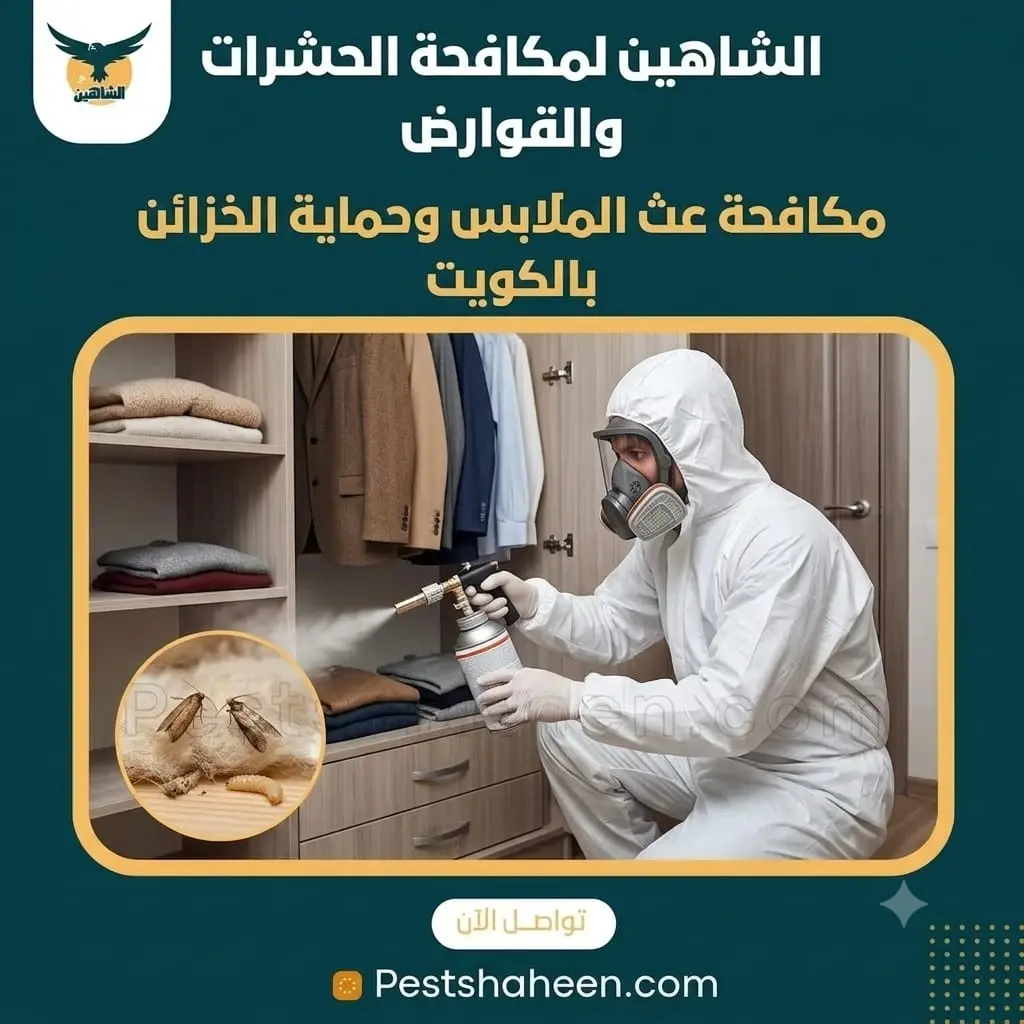
Effective clothes moth control in Kuwait begins by understanding that seeing a small moth inside the home does not automatically confirm a clothes moth infestation. Many different moths and small flying insects can enter homes, and some have no connection to fabrics at all. This is why diagnosis depends more on the type of damage, where it appears, what materials are affected, and what is stored inside the wardrobe.
Clothes moth larvae are more closely associated with materials containing animal-based fibers such as wool, cashmere, fur, feathers, and certain blended fabrics containing these materials. Larvae may also benefit from residues such as perspiration, skin particles, hair, and other organic material left on stored garments. This is why a garment stored without cleaning may be more attractive than a clean item stored properly.
The wardrobe itself needs to be inspected as well, not only the clothes. Lower corners, drawer edges, areas behind shelves, and places where lint or hair collect are important because larvae often prefer quiet and relatively dark areas where their activity can remain unnoticed.
One common mistake is seeing a single moth and immediately spraying household pesticide directly onto all clothing. This can damage fabric and may still fail to reach hidden larvae. A better approach is to separate affected items, identify the material, and choose a cleaning or treatment method suitable for each piece.
At Al Shaheen, we first determine whether the problem is actually clothes moth activity and whether it is limited to one wardrobe or extends to other rooms or stored textiles.
-
The infestation is identified from the damage pattern fabric type and activity location rather than from seeing one small flying moth because not every moth inside the home feeds on clothing
-
Natural and animal-based fibers such as wool cashmere fur and feathers receive greater attention because these materials can support clothes moth larvae
-
Wardrobe corners drawers and areas where lint and hair collect are inspected because the infestation may continue outside the visibly damaged garment itself
-
Directly spraying clothing is not treated as an automatic step because every fabric requires appropriate handling and household pesticide should not be applied randomly to textiles
Clothes Moth Control Company
Choosing a clothes moth control company is different from choosing a company for insects that simply move across floors and exposed surfaces. The company needs to understand how to separate the infestation source, existing fabric damage, and garments that can still be protected.
A professional company asks about the first item where damage was discovered, where it had been stored, whether the garment was clean before storage, and whether the wardrobe is opened frequently or left closed for several months. These details help explain why activity may have developed in that particular location.
The company should also ask about wool rugs, blankets, winter clothing, stored fabrics, feathers, or other natural materials in the same room because the original source may not be the wardrobe itself. Sometimes larvae develop in another textile and are later introduced into the closet with stored clothing.
A strong company does not begin with pesticide. It begins by separating items, inspecting the wardrobe, organizing cleaning, and deciding which garments need washing, professional dry cleaning, or another appropriate treatment according to the fabric and its care instructions.
The company should also explain that existing damage does not disappear after the infestation is controlled. A hole in an expensive garment may still require sewing, textile restoration, or specialist repair.
At Al Shaheen, protecting the clothing is treated as part of the service rather than focusing only on killing the insect because the real objective is to prevent additional garments from being damaged.
-
A specialized company looks for the infestation source inside or outside the wardrobe instead of focusing on one damaged garment while leaving the surrounding environment unchecked
-
Clothing is classified according to fabric type and infestation condition so the same cleaning or treatment method is not used for every item
-
Expensive or delicate garments should follow their care instructions or receive specialist cleaning instead of being exposed to products that could cause discoloration or damage
-
Company performance is judged by stopping new damage and protecting remaining clothing rather than simply making adult moths disappear from view
Getting Rid of Clothes Moths
Successfully getting rid of clothes moths requires managing the full life cycle because killing adult moths alone does not stop damage if larvae remain inside the wardrobe or between fabrics. Eggs may be very small and difficult to see, after which larvae emerge, feed on suitable materials, and eventually develop through later stages before adult moths appear.
An important step is separating affected or suspicious garments from unaffected items so the problem is not continuously moved from one shelf to another during sorting. Each garment should then be handled according to its fabric type and washing or care instructions.
Vacuuming also plays an important role inside the wardrobe, especially in corners, along edges, beneath drawers, and in areas where lint and hair accumulate. Removing this material reduces additional resources that developing larvae may use.
Garments that have not been worn for a long time also deserve attention. These items should be inspected before being returned to storage because an infestation may have progressed without anyone noticing.
Cleaning the wardrobe while leaving affected clothes inside it is a mistake. The opposite is also ineffective: cleaning the garments while ignoring the wardrobe allows the same environmental conditions to remain.
At Al Shaheen, we organize the process so the wardrobe and its contents are treated as one system instead of as separate steps that do not support each other.
-
Affected and suspicious garments are separated from other clothing so larvae or eggs are not moved repeatedly between shelves during sorting
-
Cleaning methods are selected according to the fabric and care instructions rather than using heat or products that may damage the material
-
Wardrobe vacuuming focuses on corners edges and lint accumulation zones because these areas may support immature moth stages
-
Effective control requires addressing both the clothing and the wardrobe environment because treating only one side reduces the chance of stable long-term control
Clothes Moths in the Wardrobe
Finding clothes moths in the wardrobe means the closet itself has become an environment that needs assessment rather than simply being treated as a neutral storage space. A wardrobe that stays closed for long periods and contains tightly packed garments provides quiet and relatively dark conditions that can allow an infestation to remain unnoticed.
The first areas worth checking include the wardrobe floor, spaces beneath hanging garments, rear corners, and drawer edges. Dust, lint, hair, and loose textile fibers often accumulate in these places and can support larvae.
Heavy overcrowding also makes inspection difficult. When clothes are tightly compressed together, the rear side of a garment may remain unseen for months. Leaving reasonable spacing and organizing clothes properly makes inspection easier and allows early signs to be noticed.
Seasonal clothing stored inside open bags or cardboard boxes within the wardrobe also deserves attention because these items may remain undisturbed for long periods. Ideally, seasonal clothing should be cleaned, fully dried, and stored in a way appropriate for the material.
Wooden shelves and joints should also be checked, not because clothes moths eat wood, but because small protected gaps around the structure can provide hiding places for larvae or pupae.
At Al Shaheen, we treat the wardrobe as a space that needs cleaning, organization, and later monitoring rather than as a piece of furniture that simply receives one spray application.
-
Wardrobe floors rear corners and protected edges are inspected because quiet dark areas are more likely to support hidden moth stages than frequently disturbed sections
-
Excessive clothing congestion is reduced so garments can be checked easily and large concealed areas do not remain untouched for months
-
Seasonal garments are stored clean dry and appropriately protected rather than being left in open bags or cardboard boxes for long periods
-
Better wardrobe organization after treatment makes it easier to identify new signs early before damage spreads to a larger group of garments
Clothes Wardrobe Moth Control
Clothes wardrobe moth control should be planned according to the size, design, and use of the wardrobe. A closet opened every morning for daily clothing is different from a large dressing room containing seasonal sections that may stay untouched for months.
In larger wardrobes, areas can be divided according to activity. If damage is limited mainly to the wool section, there is no reason to assume that every cotton garment has the same level of infestation. However, nearby sections still need inspection to determine whether activity has spread.
Shelves and drawers should be mostly emptied during cleaning so edges, joints, and hidden surfaces can actually be reached. If everything stays in place, only exposed surfaces are cleaned while the important concealed areas remain untouched.
After cleaning, garments should be returned in an organized way without excessive compression. Seasonal clothing can be placed in suitable sealed containers or storage bags after it has been cleaned and thoroughly dried.
The goal is not to make the wardrobe permanently sterile. It is to make the environment less supportive of clothes moth activity and easier to inspect in the future.
At Al Shaheen, we give customers a simple monitoring approach based on infestation severity so they know how to check whether the problem has ended or whether new activity is appearing.
-
The wardrobe is divided into sections according to garment type and damage location so treatment remains focused instead of treating every item in exactly the same way
-
Drawers and shelves are cleaned after their contents are removed so joints and edges that remain hidden when full can be reached properly
-
Seasonal clothing can be stored in suitable sealed containers after cleaning and drying to reduce exposure during long periods of non-use
-
Periodic wardrobe checks after control help identify new activity before it spreads to a larger collection of clothes
Spraying Wardrobes Against Moths
Spraying wardrobes against moths requires caution because a wardrobe comes into direct contact with clothing, and it is not appropriate to spray any household pesticide inside and immediately hang garments back over treated surfaces. The product and method need to be suitable for the intended use, and its label instructions must be followed carefully.
Before any application, clothes and personal belongings should be removed from the wardrobe. Pesticide should not be sprayed directly over garments or between fabrics unless the specific product clearly allows that type of use and the instructions are followed exactly.
After treatment, required drying, ventilation, and re-entry instructions depend on the product being used. Garments should not be returned until the wardrobe is ready according to those directions.
Some infestations may not require chemical spraying inside the wardrobe at all if cleaning, isolation, and treatment of affected garments provide an appropriate solution. This is why spraying should not automatically be included in every clothes moth service.
Using more pesticide does not create stronger protection. Excess application may create unwanted odor, residue, or unnecessary exposure without improving the result.
At Al Shaheen, chemical treatment is used only when it has a clear role in the control plan while clothing and personal items are kept outside the application area.
-
Wardrobes are emptied before chemical application so clothing is not unnecessarily exposed to the treatment product
-
The product must be suitable for the intended location and used according to its instructions instead of applying any household pesticide inside the closet
-
Clothing is returned only after the required drying ventilation and waiting period specified for the product
-
Spraying is not mandatory in every infestation because some cases can be managed more effectively through cleaning isolation and treatment of affected garments
Treating Clothes Moth Larvae
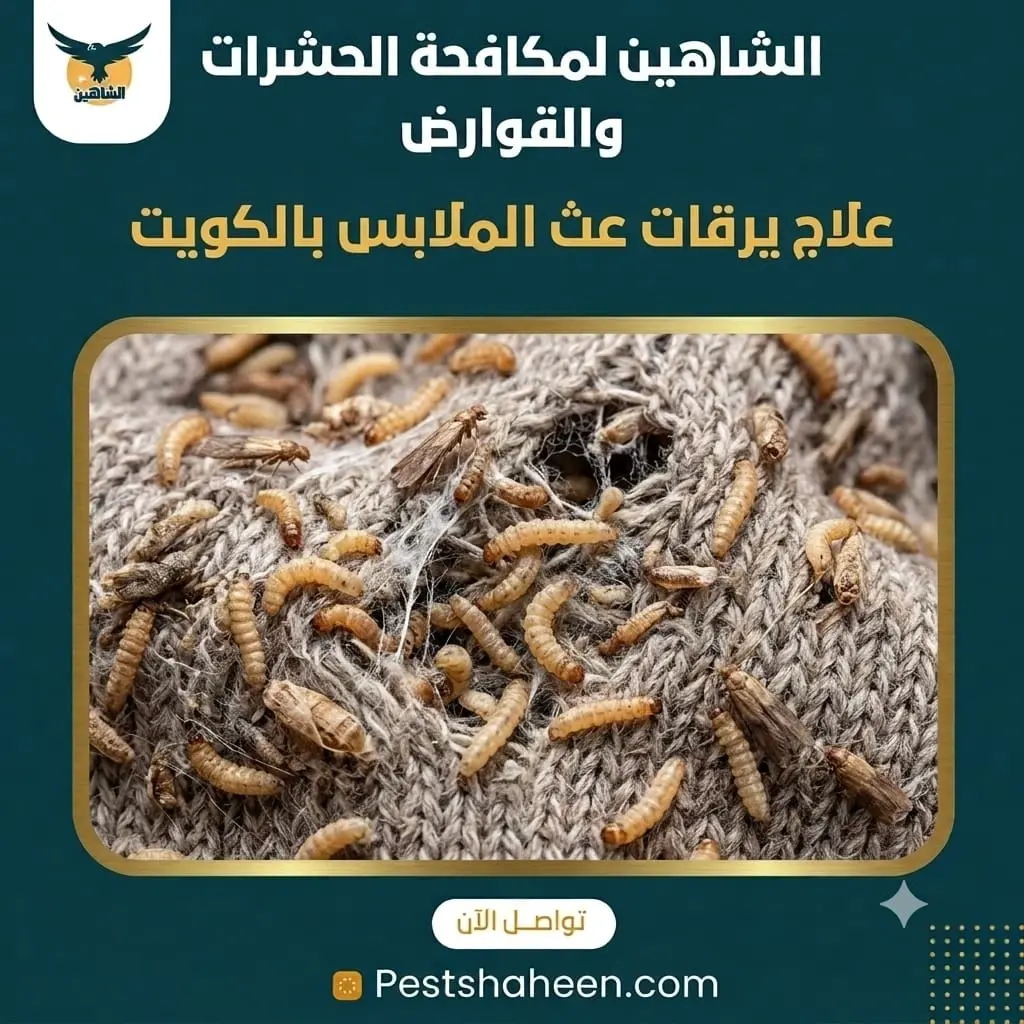
Treating clothes moth larvae is more important than focusing only on adult moths because the larvae are the stage responsible for feeding on fibers and creating holes in clothing. Adult moths are mainly involved in reproduction, while the damage noticed by homeowners is usually caused by larval feeding.
Larvae prefer quiet locations and may hide within folds of fabric, beneath shelves, or inside corners where lint accumulates. This means seeing a flying moth does not automatically tell you where the larvae are located.
Possible signs of larval activity can include webbing, small cases, or feeding marks depending on the species, but damage does not always look identical. The fabric type and storage location therefore need to be considered together.
Larval control depends on managing affected garments, cleaning the wardrobe, and removing loose fibers, hair, and lint. Some clothing may benefit from treatment suitable for the material, such as professional cleaning or another fabric-appropriate method according to care instructions.
The objective is not to visually find every larva because that is unrealistic. A more practical goal is to reduce all the conditions that allow larvae to survive and continue feeding.
At Al Shaheen, we explain that the disappearance of adult moths from the room is not enough to judge success if the stage responsible for fabric damage has not been addressed.
-
Larvae receive priority because they are responsible for feeding on fibers and producing holes in garments
-
Fabric folds wardrobe edges and protected corners are inspected instead of searching only for flying adult moths
-
Treatment methods for individual garments are selected according to fabric type and tolerance so larval control does not cause greater damage to the clothing
-
Results are evaluated by the absence of fresh damage and new signs rather than only by whether adult moths are still visible
Insects That Eat Clothes in the Wardrobe
The phrase insects that eat clothes in the wardrobe does not always refer to clothes moths because other textile pests, including certain carpet beetle larvae, can also damage fabrics. Accurate identification is therefore important before selecting treatment.
The pattern of damage can provide clues but should not be treated as a final diagnosis by itself. Different textile pests may create different holes, shed skins, debris, or other traces. The type of fabric being damaged can also help narrow down the possibilities.
If the damage is concentrated mainly in wool or other natural animal-based fibers and occurs inside a quiet wardrobe, clothes moths may become a stronger possibility, but other evidence still needs to be considered.
Finding a small insect near the wardrobe does not automatically mean it caused the damage. It may simply have entered through a window and have no connection to the affected garments. The relationship needs to be supported by evidence linking the pest to the damaged fabric.
At Al Shaheen, we aim to identify the textile pest as accurately as possible because using a clothes moth treatment strategy against another pest can lead to weak or incomplete results.
-
Damage pattern and fabric type are compared before concluding that clothes moths are responsible because carpet beetles and other pests can also damage textiles
-
Finding an insect near the wardrobe is not enough to prove it caused the damage without additional supporting signs
-
Damage concentrated on wool or animal-based fibers is an important clue but should be considered together with the rest of the inspection findings
-
Correct identification prevents repeated unsuitable treatments and helps determine which pest life cycle actually needs to be targeted
Protecting Clothes from Moths
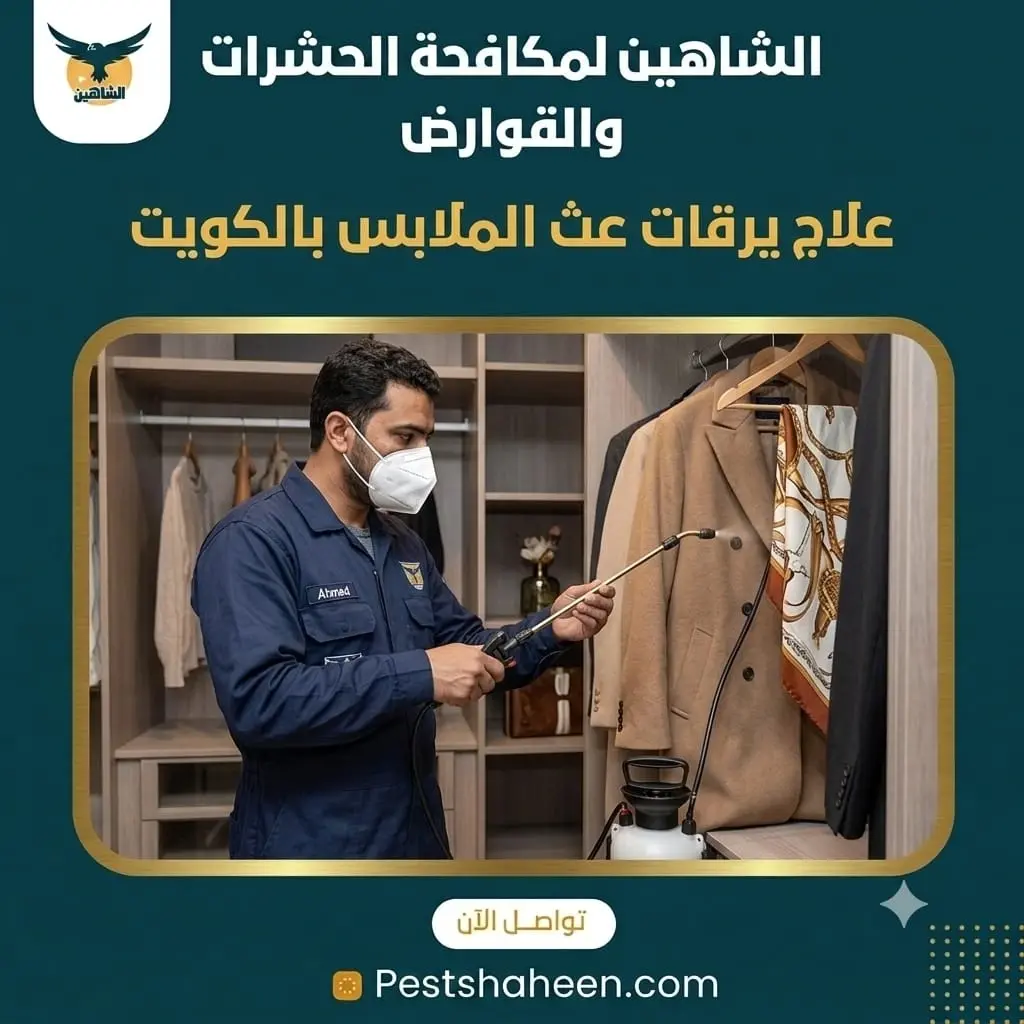
Protecting clothes from moths is most effective when prevention starts before holes appear rather than relying on routine pesticide spraying without a reason. One of the most important steps is storing garments when they are clean because perspiration, skin residue, hair, and other organic material can make some items more attractive to larvae.
Seasonal clothing should ideally be cleaned before storage, allowed to dry completely, and then placed in suitable protective bags or containers that reduce insect access as much as practical. Storing damp or dirty clothing creates additional problems instead of protecting the garment.
Opening wardrobes and checking stored clothing from time to time is also useful, especially with valuable items that are rarely worn. A small sign detected early can be handled before activity spreads to additional garments.
Vacuuming and cleaning wardrobe corners also reduces lint and hair that may support larvae. Old clothing that has not been used for years should not simply remain densely packed in the same wardrobe indefinitely.
Some people rely heavily on fragrances or scented products as their main prevention strategy, but scent alone does not replace cleaning, proper storage, and regular inspection.
At Al Shaheen, we focus on preventive habits customers can maintain long term without turning every wardrobe into an area filled continuously with pesticides.
-
Clothing is cleaned before storage because garments carrying perspiration hair or organic residue may become more attractive to clothes moth larvae
-
Seasonal clothing is stored in suitable sealed protection after it is fully clean and dry to reduce exposure during months of non-use
-
Regular checks of valuable or rarely used garments help identify damage early before it spreads to more items
-
Prevention depends more on cleanliness organization and monitoring than on constantly using fragrances or pesticides inside wardrobes
Clothes Moth Control Price
The clothes moth control price depends more on infestation size, number of wardrobes, type of stored clothing, and service scope than on the number of adult moths a customer sees. A small wardrobe with localized activity is different from a full dressing room containing wool garments, blankets, and stored rugs.
If the wardrobe contains many items that need sorting and inspection, the service naturally takes more time. Delicate or high-value fabrics also require greater care and may need specialist cleaning that falls outside the pest control company’s direct service.
Customers should understand exactly what the price includes. Does it cover inspection and treatment of one wardrobe only or several closets? Is follow-up included? Are garment cleaning or dry-cleaning services part of the quotation or separate?
The cheapest service is not necessarily good value if it consists only of quickly spraying inside the wardrobe without checking the garments or identifying the source. A higher price is also not automatically evidence of quality if there is no clear treatment plan.
At Al Shaheen, we link the price to the actual infestation scope and explain what the service includes so customers can compare quotations fairly.
-
Wardrobe number size and the type of stored fabrics influence the cost because inspecting a full dressing room is different from treating one small closet
-
Delicate or high-value garments may need specialist cleaning outside the pest control service and this should be explained from the beginning
-
A clear quotation should state whether follow-up is included and which wardrobes are covered instead of providing one general price without scope
-
The better price is connected to diagnosis cleaning and planned treatment rather than a quick visit based only on spraying inside the wardrobe
Conclusion
Clothes moth control in Kuwait and wardrobe protection works best when the problem is treated as an infestation connected to clothing, storage conditions, wardrobe structure, and the moth life cycle rather than simply as one small flying insect inside the room. The larvae are the stage responsible for the actual fabric damage, so treatment needs to focus on where they are developing, what they are feeding on, and which garments remain at risk.
At Al Shaheen, we begin with identification and determine whether the pest is genuinely a clothes moth or another textile pest. We then separate suspicious garments, clean the wardrobe, and select an appropriate way to handle each fabric type.
We also avoid unnecessary treatment of clothing. Not every garment needs pesticide, and not every wardrobe needs the same program. High-value or delicate textiles should always be handled according to their care requirements in a way that reduces the risk of damage.
Prevention after treatment depends on storing clothing clean and dry, checking seasonal garments, cleaning wardrobe corners, and preventing lint and hair from accumulating for long periods.
Frequently Asked Questions
How can I tell whether holes in my clothes are caused by clothes moths?
Holes in natural fabrics, especially wool, can be a sign of clothes moth activity, but they are not enough on their own because other textile pests such as carpet beetle larvae can cause similar damage. The fabric type, damage pattern, and pest evidence all need to be considered.
Is the adult moth the stage that eats clothes?
Usually, the larvae are responsible for feeding on fibers and causing damage, while the adult moth is more closely associated with reproduction.
Do clothes need to be sprayed directly?
Not automatically. Many garments should be cleaned or treated using methods appropriate for the fabric, and random household pesticide should not be applied directly onto clothing.
Which clothes are most attractive to moths?
Materials containing animal-based fibers such as wool, cashmere, fur, and feathers are more vulnerable, especially when stored without proper cleaning.
Is washing clothes enough to eliminate moths?
That depends on the fabric, infestation stage, and care instructions. Cleaning affected garments is important, but the wardrobe and surrounding environment also need attention if the infestation is established there.
Do I need to throw away infested clothes?
Not always. Some garments can be cleaned or repaired depending on the severity of the damage, fabric type, and value. Severely damaged items may require a different decision.
Do clothes moths live only inside wardrobes?
Not necessarily. Activity may also be connected to rugs, blankets, stored fabrics, or other natural materials elsewhere in the home, so the source may need to be investigated outside the wardrobe.
Do scented products prevent clothes moths?
Fragrance alone is not a substitute for cleaning, proper storage, and regular inspection. Stronger prevention comes from reducing food sources and protecting garments during storage.
What determines the price of clothes moth control?
The number and size of wardrobes, amount of clothing, type of fabrics, infestation spread, and follow-up requirements can all affect the final price.
How do I choose a clothes moth control company?
Choose a company that can distinguish clothes moths from other textile pests, inspects both the wardrobe and clothing before treatment, explains what needs cleaning or treatment, and protects unaffected garments without relying on unnecessary direct pesticide use.