Moisture Pest Control in Kuwait and Treating the Root Cause
Finding small insects around a bathroom, under a sink, or beside a wall affected by water is not a problem that should automatically be treated as a simple pest issue requiring pesticide. In many cases, the location itself provides clues about environmental conditions that support the pest, such as organic buildup, slow drainage, condensation, or hidden dampness. This is why moisture pest control in Kuwait and treating the root cause should begin by identifying the pest and understanding its relationship with the affected area before selecting a control method. At Al Shaheen, we separate the infestation source from the moisture source and from any damage caused by water, then define the role of each step clearly so treatment targets the real problem instead of repeating the same spraying every time insects appear again.
Moisture Pest Control in Kuwait
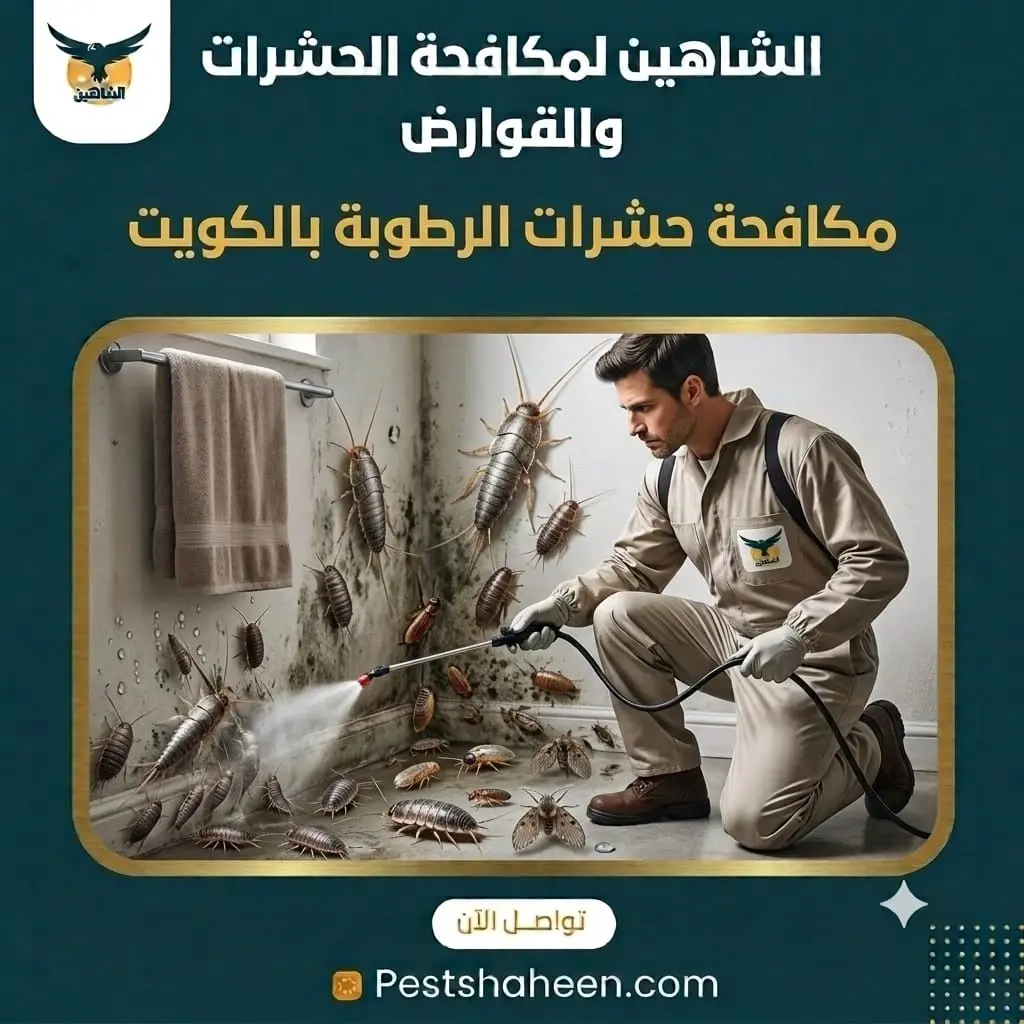
Effective moisture pest control in Kuwait begins with one very important point: the term “moisture pests” is not the scientific name of one particular insect. A customer may use this phrase when they see tiny insects near a bathroom, insects gathering around a drain, small organisms on a damp wall, or a pest moving near flooring that takes a long time to dry. Treating all these situations as one problem often leads to the wrong service because each pest group has different behavior, food sources, and breeding conditions.
For this reason, the first stage at Al Shaheen is to examine the insect itself. We consider its approximate size, color, movement, whether it jumps, crawls, or flies, and whether it appears individually or in groups. We then connect those details to the location. Is the activity limited to the bathroom? Is it concentrated near a drain? Does it appear on a wall, beside a window, or inside the cabinet beneath a sink?
The next step is to assess the surrounding area without immediately assuming that water is the direct cause. The insects may be associated with organic buildup around drainage, may be using concealed wall voids, or may have entered from outside and simply been noticed near a damp area by coincidence.
This is where the difference between diagnosis and routine spraying becomes clear. Once the most likely pest group has been identified, we can determine what needs to be inspected next, which areas deserve priority, and which applications are unnecessary.
At Al Shaheen, we use the phrase moisture pests as a starting point for investigation rather than as a final diagnosis so the treatment remains as evidence-based as possible.
-
The insect’s appearance movement and location are assessed before treatment because pests associated with drains behave differently from insects that benefit from damp walls or wet organic material
-
Each sighting is linked to the surrounding conditions such as a drain window cabinet or organic buildup instead of assuming that humidity alone explains every case
-
The inspection determines whether one pest is responsible for the activity or whether several small household pest issues are occurring in nearby areas
-
Accurate identification reduces unnecessary pesticide use and prevents repeated treatment aimed at a pest that is different from the one actually present
Getting Rid of Moisture Pests
Successfully getting rid of moisture pests involves removing the environmental factors that allow insects to remain in the area after they arrive. This does not refer only to the water source. It also includes accumulated organic material, compacted dust, food debris, damp towels, cardboard, and stored objects in places that are not cleaned regularly.
For example, the area beneath a kitchen sink may remain mostly dry but still contain old cardboard, paper, and debris around plumbing connections. In another case, the space behind a washing machine may contain lint, dust, and occasional moisture from normal use. These small hidden details can matter more than the large section of floor that is cleaned every day.
Effective control starts by clearing the area where activity is concentrated so the edges, corners, wall junctions, and floor connections can actually be seen. Debris can then be removed, along with materials that retain moisture or make access difficult.
The cleaning method also needs to suit the location. A quick wipe does not always reach cabinet joints, areas beneath appliances, or spaces around pipe penetrations. Vacuuming and suitable cleaning tools may be more useful in those locations than simply applying more cleaning solution.
The activity is then monitored after the area has been reorganized. If insect numbers fall noticeably, storage and sanitation conditions were probably contributing to the problem. If activity continues in the same pattern, another diagnostic angle needs to be investigated rather than repeating the same cleaning routine.
At Al Shaheen, we explain which objects should be moved and which areas need continued attention so the same hidden environment is not recreated a few weeks later.
-
Cardboard stored items and materials that retain moisture are removed from active areas instead of cleaning only visible surfaces while concealed conditions remain unchanged
-
Spaces beneath appliances cabinet edges and plumbing penetrations are included because they often fall outside normal daily cleaning routines
-
Cleaning that removes food and shelter is separated from ordinary disinfecting because a strong cleaner does not replace removal of the actual buildup
-
The area is reorganized after cleaning so it remains accessible for future inspection instead of returning everything to the same arrangement that originally concealed the problem
Moisture Pests in the Home
Understanding moisture pests in the home depends heavily on how activity is distributed between rooms rather than simply on the first place where the customer notices an insect. Activity limited to one bathroom creates a very different diagnostic picture from insects appearing in two bathrooms, the kitchen, and the laundry room at the same time.
When the problem is limited to one area, the inspection focuses on a local condition within that space. If the same insect appears in several separate areas, the assessment becomes broader and may include ventilation patterns, service routes, storage areas, or other environmental conditions shared between rooms.
The distribution pattern also helps determine priorities. Not every room needs the same level of treatment simply because a pest was found somewhere else in the house. Areas with confirmed activity receive more detailed inspection, while unaffected spaces are assessed according to their connection with the problem.
Comparing similar rooms can provide particularly useful evidence. If the main bathroom has activity while another bathroom with a similar layout remains unaffected, we ask what is different between them. Is one drain functioning differently? Is ventilation weaker? Is a cabinet covering part of the wall? Is one room used much more frequently?
We also ask when the problem began in relation to any maintenance or property changes. Did the insects appear after plumbing work, new tiles, cabinet installation, an air-conditioning issue, or a room being closed for a long period? The sequence of events can provide information that the insect itself does not reveal.
At Al Shaheen, we create a simple activity map instead of treating the home as one uniform space. This reduces unnecessary treatment and can also reveal whether more than one source is involved.
-
Each location where insects appear is compared with unaffected areas so differences in conditions become visible instead of assuming the whole property has the same problem
-
Activity across several rooms helps determine whether there is one shared environmental factor or several separate local sources
-
Rooms without actual signs remain part of the inspection and monitoring process but are not automatically given the same level of chemical treatment
-
Maintenance history and changes within the home help connect the beginning of the infestation with a particular event instead of relying only on present conditions
Bathroom Insects Caused by Moisture
Bathroom insects caused by moisture require a separate type of assessment because a bathroom contains several different micro-environments within a relatively small area. There are drains, sinks, toilets, showers, steam, towels, cabinets, and utility openings, and each one can support a different type of pest activity.
If insects concentrate around a drain, priority is given to inspecting the drainage area and any buildup associated with it rather than spraying the entire bathroom wall. If they appear inside the vanity cabinet, the plumbing connections, stored materials, and the cabinet’s relationship with the surrounding wall need closer attention.
If activity becomes more noticeable after showers or when steam remains trapped in the bathroom for long periods, the speed of drying and air movement become important factors. On the other hand, if insects continue appearing even when the bathroom has not been used for many hours, a different source may be involved.
Small everyday items can influence the environment as well. A floor mat that stays wet throughout the day, towels left in a pile, a bucket containing standing water, or a section around the shower base that remains damp can create very different conditions from a bathroom that is ventilated and dried regularly.
A common mistake is pouring pesticide or strong cleaner into every drain immediately after an insect is seen. This may be inappropriate for the pest or location and does not solve the problem if the true source is buildup or leakage elsewhere.
At Al Shaheen, we divide the bathroom into separate functional zones and determine which one is most closely connected with the activity before selecting a response.
-
When activity is connected with drainage the drain area and associated buildup receive focused inspection instead of distributing treatment randomly across the entire bathroom
-
When insects appear beneath a sink the cabinet plumbing connections and stored materials are assessed together rather than concentrating only on the floor
-
Wet mats towels and items that remain damp for long periods are included in bathroom management because they can create small independent micro-environments
-
The timing of insect activity in relation to water use helps distinguish between a problem associated with normal daily moisture and a source that remains active even when the bathroom appears dry
Spraying Pests in Damp Areas

Spraying pests in damp areas requires a clear technical reason because pesticide application should not be automatic simply because moisture is present. The most important questions before treatment are where the pest is actually located, whether the product is suitable for that location, and whether the application can reach the area the insect is using.
If an insect hides inside a dry crack beside a damp area, localized treatment may have a useful role. However, spraying a surface that is washed with water several times a day may offer much less value because the treatment is repeatedly disturbed or removed.
Different surfaces also need different consideration. Ceramic tiles are not the same as timber, a cabinet is not the same as a drain, and a painted wall is not the same as a food-contact surface. Product selection therefore depends on the label and permitted use rather than on one general rule for all damp-area pests.
Before spraying, personal belongings, food-related items, and children’s products are removed or protected according to the location and product directions. After treatment, ventilation, re-entry, and cleaning instructions are followed according to the specific product instead of applying one fixed waiting period to every situation.
Another mistake is judging treatment strength by odor. Some customers assume that the strongest pesticide is the one with the most noticeable smell or the longest-lasting odor. That is not a reliable measure of effectiveness. Good treatment depends on placing an appropriate product in the correct location at the correct amount.
At Al Shaheen, spraying is used only when it adds real value to the wider plan and is never treated as a substitute for identification or necessary maintenance.
-
Application points are selected according to pest movement and hiding areas instead of wetting entire floors and walls with a product that does not need to cover the whole space
-
Surfaces that are repeatedly exposed to water are assessed differently because frequent washing can influence whether pesticide application is useful there
-
Bathrooms and kitchens require additional protection of personal items utensils and sensitive surfaces before any chemical treatment
-
Product directions are followed for application re-entry and cleaning instead of increasing concentration or exposure time in the belief that this will produce a stronger result
Treating Pests Caused by Water Leaks
Treating pests caused by water leaks differs from other moisture-related cases because there is a specific technical event that has changed the condition of the property. A leak may be small but continuous, or it may have been a major one-time incident that left materials saturated with moisture. Each situation requires a different assessment.
The first task is to determine how far the water has traveled rather than looking only at the visible leak point. A pipe leaking behind a wall may affect gypsum, timber, the base of a cabinet, flooring, or hidden internal voids even when the visible stain appears relatively small.
Once the plumbing issue is repaired, the condition of the affected materials should be evaluated separately. Swollen wood, weakened gypsum, damaged silicone, or deteriorated finishes may need additional repair because controlling an insect does not restore damaged materials to their previous condition.
Timing matters as well. Some building materials can retain moisture after the active leak has stopped. Closing the wall or repainting too quickly before the material has reached an appropriate condition can conceal the consequences of the problem rather than resolving them.
The pest control company’s role is to identify and manage insect activity associated with the affected area when necessary. Locating and repairing defective pipes, waterproofing, or other building faults belongs to the relevant maintenance specialist.
This prevents one of the most common mistakes: repeatedly paying for pest spraying while a plumbing connection behind the sink continues to leak. In that situation, the visible consequence is being treated while the condition that recreates it remains unchanged.
-
The spread of moisture through surrounding materials is evaluated rather than focusing only on the visible point where water appears
-
Pest treatment is separated from repair of gypsum timber waterproofing or finishes because each part requires a different technical specialist
-
Repainting or closing an affected area should only happen after its condition has been properly assessed rather than covering material that may still retain moisture
-
If pest activity returns after a leak has been repaired the area is reassessed for another damp location or an additional source before simply choosing a stronger pesticide
Small Insects Caused by Moisture
The phrase small insects caused by moisture is too broad to function as a final diagnosis. Many household pests are small, but differences in movement, location, color, and timing can separate one group from another.
An insect that jumps when disturbed provides different information from one that crawls slowly. A small flying insect emerging near a drain creates a different diagnostic direction from tiny organisms moving across a wall. Even the exact gathering point matters, whether it is close to a light source, inside a corner, beside a window frame, or under a sink.
Clear photographs can save considerable time. Ideally, the insect should be photographed closely while stationary, with another object providing some sense of scale. If it is practical to retain a specimen safely inside a small container without direct handling, this can sometimes help with identification.
The timing of activity should also be recorded. Does it happen only at night? After using the shower? After washing the floor? During a particular season? After the air conditioner is switched on? These patterns can narrow the possibilities substantially.
It is equally important not to treat every tiny insect as a major infestation before identification. Some cases remain very limited and decline after a small environmental adjustment, while others require more focused intervention.
At Al Shaheen, the customer’s observations are treated as useful inspection information because the time and location of insect activity can sometimes be more informative than the number visible during the technician’s visit.
-
Whether the insect jumps flies or crawls helps rule out entire pest groups and makes identification more precise
-
A close clear photograph is more useful when it shows body shape and relative size instead of relying on a general description such as a tiny black insect
-
Recording when and under what conditions insects appear helps determine whether activity is associated with water lighting or another environmental factor
-
Identifying the pest before spraying prevents widespread treatment for a problem that may respond better to a simple change in cleaning or environmental conditions
Controlling Moisture-Related Pests Inside the Home
Effective control of moisture-related pests inside the home requires integrated management across different areas rather than carrying out several unrelated services. A property may have a drainage issue in one bathroom, an old leak beneath the kitchen sink, and condensation in the laundry room, with each location needing a different response.
The first step is to rank problems according to priority. A continuous water source behind a wall receives greater attention than temporary dampness that disappears after normal use. An area with substantial ongoing insect activity is also addressed before a room containing only an old isolated sign.
Responsibilities are then separated. Some actions can be handled by the homeowner, such as organizing stored items and cleaning accessible edges. Others require a plumber, waterproofing specialist, air-conditioning technician, or pest control professional.
The next stage is preventing the same environmental conditions from returning. This may include monitoring silicone around wet areas, maintaining drains as needed, avoiding piles of water-absorbing materials in service rooms, and keeping inspection points accessible.
Sealing cracks and openings can also contribute to prevention when appropriate, but they should not be closed before confirming that there is no hidden leak or another condition requiring access.
At Al Shaheen, integrated management is not about adding more procedures. It is about arranging the right procedures in the right order so each step solves a different part of the problem rather than repeating pesticide use from room to room.
-
Areas are prioritized according to pest activity and how continuously they provide supportive conditions so the most important source is addressed first
-
The plan separates tasks the homeowner can manage from work requiring maintenance specialists or professional pest control
-
Preventive maintenance of drains silicone joints and service areas reduces the chance of new hidden moisture points developing after the initial service
-
Cracks and access points are sealed only after hidden water problems have been ruled out so cosmetic closure does not conceal a leak or pest activity that still needs access
Causes of Moisture Pest Activity
Understanding the cause of moisture pest activity often requires looking backward and asking what changed before the insects appeared. The trigger is not always an obvious plumbing leak. Sometimes a relatively small change alters the way the area dries or is maintained.
Installing a new cabinet directly against a wall that previously had good airflow can reduce ventilation behind it. Placing a rug or storage unit over a cooler section of flooring can slow drying. Keeping a room closed for a long period or changing the way air conditioning is used can also alter indoor conditions.
In other situations, the change develops gradually. Bathroom silicone deteriorates slowly, a drain becomes less efficient over time, or a connection begins leaking in such a small amount that nobody notices it immediately. The insects may appear later and become the first sign that draws attention to the underlying change.
Water stains, peeling paint, damp odors, and changes in timber color or texture should all be treated as maintenance indicators even if very few insects are present. The size of an insect population does not necessarily reflect the size of the building or moisture problem.
The key question is therefore not only “What is this insect?” but also “Why has it started appearing now after months or years without a problem?”
At Al Shaheen, the history of the affected area forms part of the diagnosis because identifying the most recent environmental or property change can shorten a long process of trial and repeated spraying.
-
Customers are asked about recent changes involving furniture air conditioning finishing work storage or room use before the pest activity began
-
Slow-developing problems such as failing silicone restricted drainage or minor dripping are taken seriously because they can continue unnoticed for long periods
-
Water marks peeling paint and timber deterioration are treated as maintenance evidence even when visible insect activity is limited
-
Identifying the cause depends on combining the history of the area with the pest distribution rather than assuming every case comes from a large obvious leak
Treating the Moisture Source and Pest Activity
Treating the moisture source and pest activity is the stage where inspection findings are converted into an organized action plan. The objective is not simply to repeat the idea of stopping water. It is to establish the correct work sequence and identify which specialist is responsible for each part.
If the source is plumbing-related, the fault should be located and repaired by the appropriate technician. If waterproofing has failed, that part needs the relevant specialist. If condensation is linked to air conditioning or ventilation, the system producing those conditions should be evaluated.
Once the technical issue has been addressed, the condition of affected materials needs to be considered before pest treatment or cosmetic repair continues. Timber, gypsum, concrete, and flooring do not retain and release moisture in exactly the same way, so one fixed drying period should not be assumed for every situation.
Pest treatment is then carried out if active insects still require intervention. The necessary treatment may become very limited after the environmental source is corrected, while other cases may need a wider scope if the pest has established activity in additional areas.
The final stage is verification. The goal is not simply to carry out another visit but to compare whether new signs have stopped, whether the area has returned to a stable condition, and whether activity has appeared elsewhere.
At Al Shaheen, we consider the plan successful when there is a clear sequence from diagnosis to repair to pest management and follow-up rather than combining every issue into one spraying service.
-
Responsibility for plumbing waterproofing air conditioning and pest control is assigned to the appropriate specialist so pest technicians are not expected to repair faults outside their field
-
The condition of walls timber flooring and other materials is assessed after repair before refinishing because different materials retain moisture differently
-
The pest treatment scope is determined after the major environmental factor has been corrected so intervention can target remaining activity instead of competing with an ongoing source
-
Follow-up compares conditions before and after repair and looks for new evidence rather than judging success only by the number of insects seen on the service day
Conclusion
Moisture pest control in Kuwait and treating the root cause requires more than pesticide because it begins with identifying the pest and ends with changing the conditions that allowed it to persist inside the home. An insect appearing near a bathroom, sink, or water-damaged wall may indicate a drainage, storage, ventilation, or maintenance issue, or its presence may be connected to a completely different factor from the one the homeowner initially expects.
At Al Shaheen, we begin with identification, then assess how activity is distributed through the property, inspect the surrounding environment, and determine whether the situation requires cleaning, maintenance, pest treatment, or a combination of several steps. Every action has a specific purpose instead of repeating the same spraying in several areas.
We also maintain clear service boundaries. Plumbing, waterproofing, and repairs to damaged timber or gypsum belong to the relevant specialists, while the pest control company focuses on identifying the pest, reducing its activity, and connecting the treatment plan to the environmental conditions supporting it.
The best outcome is not simply seeing fewer insects immediately after treatment. It is understanding the source, stabilizing the affected area, achieving a sustained reduction in pest activity, and giving the customer a clear idea of what needs to be monitored afterward instead of waiting for the insects to return before starting again.
Frequently Asked Questions
Is every insect found in a bathroom a moisture pest?
No. Bathrooms contain several different environments and may attract pests associated with drains, insects entering from outside, or species that genuinely benefit from damp conditions. Identification should come before deciding on the cause.
How can I tell if the insects are connected to a drain?
If activity repeatedly concentrates around a drain or becomes more noticeable near it, the drainage area and any organic buildup should be inspected instead of immediately assuming the insects are coming from the wall.
Is cleaning the bathroom every day enough to prevent moisture pests?
Not always. Cleaning can reduce material used by certain pests, but it cannot repair a drainage problem, hidden leak, or inaccessible void if one of those is the actual source.
Do I need to spray the entire house if insects appear in several rooms?
No. The first step is to confirm whether the same pest is actually present in each room and whether those areas share a common environmental factor. The treatment scope is then based on confirmed activity.
Will a stronger pesticide stop moisture pests from returning?
Pesticide strength alone is not the solution. If the environmental conditions supporting the pest remain unchanged, activity may return. Correct placement, appropriate product selection, and correction of the underlying cause are more important than simply using more chemical.
What should I do if insects appear after a water leak?
The leak should first be repaired and the affected materials assessed. Pest activity can then be inspected to determine whether separate treatment is still necessary.
Can very small insects be identified from a photo?
A clear close-up image can help narrow the possibilities, but it may not always be enough for final identification, especially when several tiny household pests look similar.
Can poor ventilation cause the problem even without a leak?
Yes. Poor ventilation can slow drying and change local environmental conditions, but it does not explain every pest by itself. It should be considered together with other evidence.
When is spraying damp areas appropriate?
Spraying may be appropriate when the pest has been identified, there is a suitable application site, and the product label permits use in that location. It should remain one part of the overall plan rather than a substitute for correcting the cause.
How do I know that the moisture source and pest problem have been resolved?
The situation is considered under control when the technical or environmental cause has been corrected, the affected area has stabilized, and new pest signs stop appearing or activity remains consistently low without the need to repeat the same intervention continuously.