Pest Control for Food Companies in Kuwait with Routine Plans
Food companies in Kuwait cannot treat pest control as a spraying visit requested only when a problem appears because a food factory or production facility includes raw materials, production lines, storage rooms, packaging areas, loading zones, and service sections, and every part has different risks. For that reason, pest control for food companies in Kuwait requires a routine plan based on inspection, identification of activity sources, monitoring of sensitive points, documentation of observations, and review of results. The objective is not simply to eliminate the insect seen today but to reduce the possibility of recurrence and understand what allowed it to enter or hide inside the facility. A strong plan should be connected to the company's actual operating system while protecting food materials and maintaining production without indiscriminate pesticide use.
Pest Control for Food Companies in Kuwait
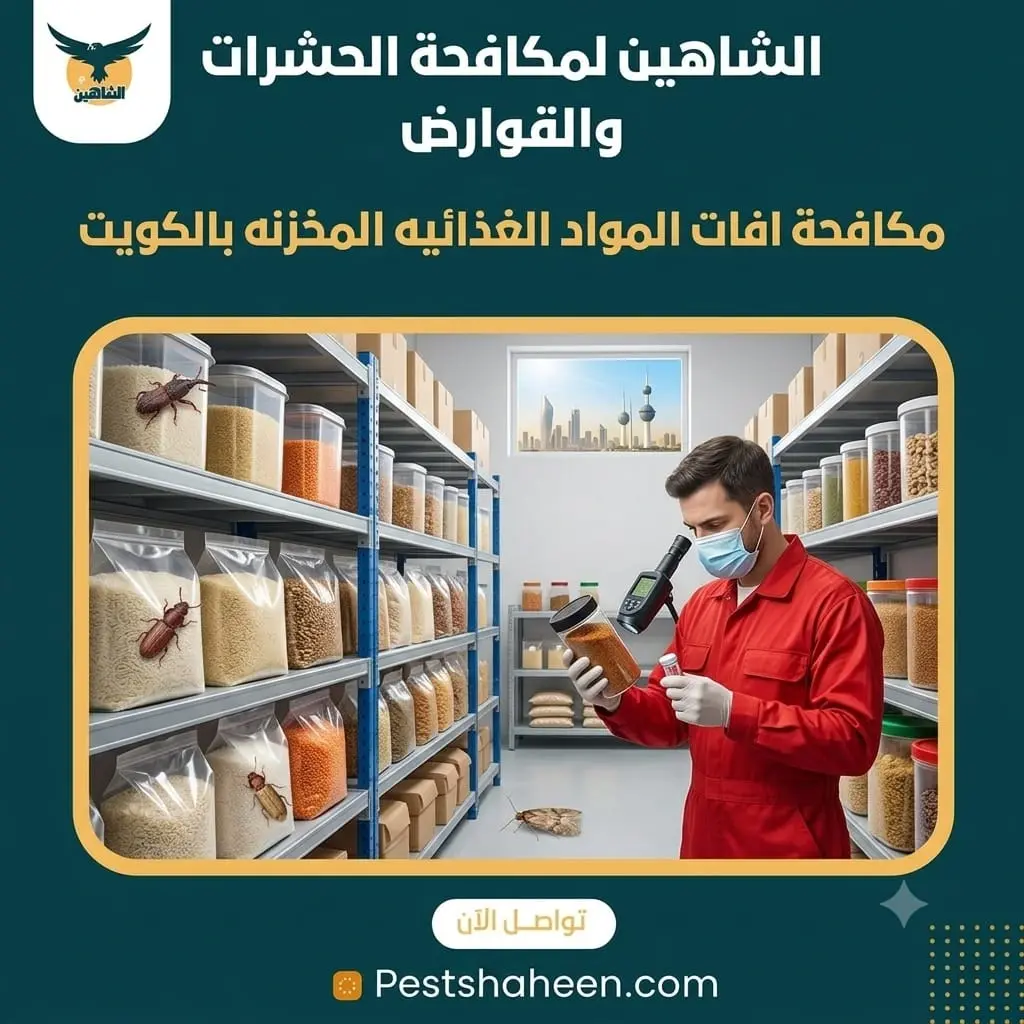
Pest control for food companies in Kuwait requires a broader approach than pest control inside a restaurant or a small shop because a food company may include raw material storage areas, production lines, cooling sections, packaging departments, finished-product warehouses, loading yards, and waste areas, and each of these locations may present a different type of pest risk.
The correct starting point is to create a practical site map and identify locations where insect or rodent activity could enter or develop. Receiving areas, for example, require attention to shipment condition, cartons, and doors, while production lines require closer inspection of spaces surrounding equipment, moisture sources, and food residues that may accumulate in areas that are difficult to reach during routine operations.
If small insects appear inside one of the warehouses, it is not correct to assume that the problem originates from the warehouse floor. The activity may be associated with a particular package, delivery, or dry ingredient, so products and nearby materials need to be assessed before any treatment is selected.
Rodent activity requires a different approach because signs may appear near loading areas, service corridors, or quieter storage sections. Droppings or gnaw marks require investigation of likely travel routes and possible entry points instead of simply placing traps without understanding the source.
A routine plan is useful because it allows management to observe how pest activity changes over time. If the same area records repeated observations every month, this indicates that an underlying cause needs to be reviewed instead of treating every occurrence as a completely new infestation.
Every observation should also be recorded by location, date, pest type, and the action taken afterward because this documentation helps determine whether the problem was resolved, moved to another area, or returned because the original cause remains.
• Dividing a food facility into operational zones helps identify the source of pest activity and connect it with receiving or storage or production or packaging instead of treating every report as though it represents the same problem
• Recording pest locations and observation dates and the action taken afterward gives management a clearer picture of recurring areas and prevents dependence on memory or verbal reports between departments
• Successful routine pest control depends on addressing entry points and moisture and food residues and openings while using control methods suited to each location instead of relying on spraying as a fixed response to every case
Pest Control Company for Food Factories in Kuwait
Choosing a pest control company for food factories in Kuwait should be based on its ability to work inside a food production environment rather than simply on its experience spraying homes or retail shops because a factory contains operating procedures, sensitive equipment, and production areas that may not be easy to stop.
A suitable company should begin by asking about the type of products manufactured, the nature of raw materials, the number of production lines, shift schedules, storage areas, and packaging operations. These details are not secondary information. They form the basis of the inspection because a dry-food facility has different conditions from a plant that relies heavily on refrigeration or continuous washing processes.
It is useful to have a responsible person from factory management accompany the first inspection and explain how materials move from receiving to final-product dispatch. This step is important because a technician who sees the site without understanding the production sequence may focus on an obvious area and overlook a point that is actually related to the problem.
If activity appears around fixed machinery or a production line, equipment should not be opened or moved indiscriminately. Certain machines require a specialist maintenance technician, while the pest control company's role is to identify the activity location and coordinate with the responsible team so access can be provided safely.
Management should also know what type of reports the company provides after each visit. A useful report identifies the location, observation, pest type, action taken, and recommendation required from the facility. A report that only says spraying was completed provides little practical value and does not help the company follow up on causes.
You can contact Shaheen Pest Control to inquire about services for food factories and food companies in Kuwait and explain the nature of the facility, the number of operational areas, and the operating schedule before agreeing on the service scope.
• A suitable company for food factories should understand material movement and production lines before pest control begins so sensitive areas can be identified without unnecessary disruption or application of products in locations that do not require them
• Having a factory representative present during the inspection helps explain continuously operating areas and machinery that requires maintenance specialists and reduces the chance of procedures affecting equipment operation or production safety
• Detailed reports after every visit are an important part of the service because they explain what was found and what cleaning and maintenance and production teams need to do instead of leaving observations without clear follow-up
Pest Control Contracts for Food Companies
Pest control contracts for food companies are different from a simple agreement for a fixed number of spraying visits because the required service should be a continuous program covering monitoring, inspection, documentation, and response to new problems according to risk levels throughout the facility.
Before signing a contract, all included areas should be clearly defined, such as warehouses, production lines, packaging sections, refrigeration areas, laboratories, utility areas, loading yards, and waste zones. If the company operates more than one building or has a separate warehouse, it should be clear whether all locations are included under the same contract or require additional arrangements.
The pest categories covered by the program should also be identified. Some contracts may include crawling insects, flying insects, and rodents, while stored-product pests or particular infestations may require a different plan depending on the type of facility and product.
A good contract should define the procedure for reports between scheduled visits. If unusual activity appears around a packaging line before the next routine appointment, management should not have to wait until the next scheduled visit. It should already be clear how the report is submitted, who is responsible for communication, and what action follows.
Periodic reports should also indicate whether a problem is improving or recurring. If the same point records pest activity during every visit, the cause should be investigated and the surrounding conditions reviewed instead of repeatedly applying the same treatment.
Another important part of the agreement is defining each party's responsibility. The pest control provider handles pests within the agreed scope, while the factory team remains responsible for completing maintenance, cleaning, or operational corrections when these are contributing factors.
• A strong contract identifies every included location and pest category and visit schedule and complaint response procedure so the service is clear to management from the first day and does not depend on verbal understandings
• Regular reviewable reports help identify areas that are improving and areas that still record activity and allow pest control decisions to be based on actual facility data
• Defining responsibility for maintenance and cleaning and repairs prevents the same problem from recurring because a known cause was not corrected and ensures every department understands what it needs to complete during the monitoring period
Rodent Control in Food Factories
Rodent control in food factories requires a plan that differs from insect control because mice and rats may travel over wide areas and use loading zones, storage rooms, utility corridors, and openings around service lines to reach several parts of a facility. For that reason, droppings or gnaw marks found in one location do not necessarily mean that the activity source is in the same place.
If signs appear near the receiving area, doors, loading points, lower gaps, and incoming shipments should be inspected. If signs are found inside a finished-product warehouse, shelving, packaging, walls, utility routes, and quiet storage locations that rodents may use for shelter need to be reviewed.
Traps and monitoring devices should not simply be placed randomly after a mouse is seen. Their location should be based on actual movement patterns and the nature of the area while keeping them appropriately positioned so workers and food materials are protected.
Any packaging showing gnawing or contamination signs should be treated as potentially affected material and isolated for evaluation according to the facility's food safety procedures instead of simply cleaning the outer surface and returning it to stock.
In larger plants, outdoor waste areas and loading yards are also important parts of the plan because continuing food sources or doors left open for long periods may allow rodent activity to return even when control measures inside the building are effective.
One major mistake is focusing only on capturing existing rodents while ignoring their entry points. If a gap under a door or around a pipe remains open, removing the current animals does not prevent new ones from entering later.
• Finding droppings or gnaw marks should lead to inspection of possible travel routes and loading areas and utility zones so rodent entry can be identified instead of simply placing a trap beside the visible sign
• Packages showing gnawing or contamination should be isolated and evaluated according to the factory's food safety system because cleaning the outside may not be sufficient when damage may have affected the contents
• Successful rodent control depends on combining monitoring methods with sealing openings and organizing waste and reviewing external doors so the facility does not remain open to renewed activity after treatment
Insect Control on Food Production Lines
Insect control on food production lines requires a high level of precision because a production line includes machinery and surfaces that may come into direct contact with food as well as internal sections that should not be accessed or treated with pesticide without understanding how the equipment operates.
If insects appear near one part of the line, the first step is to identify the activity location in relation to the food material. Are insects appearing beneath the machine, around the motor, or near a product transfer point? This difference determines the inspection method and the required scope of intervention.
Some production lines may allow small food residues to collect inside spaces that routine cleaning cannot easily reach. If these residues remain, they may provide a food source for insects even when external surfaces are clean. This is where coordination between cleaning and maintenance teams becomes important so concealed areas can be safely accessed.
Electrical equipment and parts that directly contact food should not be sprayed without a clear understanding of the selected product and the areas where it is permitted. In many situations, removing the source and treating a surrounding crack may be more appropriate than spraying the production line itself.
Production downtime can also provide useful information. Some insects may become visible after the line stops because vibration and movement decrease and insects leave hiding areas. Recording when activity appears helps the technician identify locations that need deeper inspection.
If the same production line continues to show pest activity despite repeated treatment, cleaning methods, equipment design, moisture sources, and dropped product should be reviewed rather than repeating the same pesticide application.
• Any pest activity around a production line requires identifying the insect location in relation to equipment and product before treatment is selected so pest control materials are not used on food contact parts or electrical equipment unnecessarily
• Deep cleaning of locations where food residues collect beneath or behind equipment helps remove a hidden food source that may explain repeated activity even when visible surfaces remain clean
• Repeated insect activity on the same production line requires joint review by pest control and maintenance and cleaning teams so the operational or technical cause can be identified instead of continuing the same treatment without adjustment
Integrated Pest Management Program for Food Companies
An integrated pest management program for food companies is based on a simple but important principle: pesticide is neither the first nor the only solution. The program combines inspection, monitoring, cleaning, maintenance, exclusion, waste management, correct stock handling, and the use of suitable pest control methods only when necessary.
The process begins by assessing the facility and dividing it according to risk level. Open production areas, packaging sections, and raw material storage rooms require closer monitoring than some offices or administrative corridors, but every zone should still have clearly defined monitoring points.
The next step is to identify attraction sources such as food residues, moisture, warmth, and hiding places. If the cause is a water leak, repairing the leak becomes an essential part of the solution. If the problem is connected to a loading door that remains open, reviewing operating procedures is more important than increasing pesticide use inside the warehouse.
Employee training is another important element of the program. A worker who sees an insect or rodent sign should know how to record the location and time without removing the evidence or using an unscheduled pesticide product.
A strong program depends on data. Complaint numbers, activity locations, and monitoring results are compared over time. If activity decreases in one zone but continues in another, adjustments should focus on the location where the problem remains.
One of the main advantages of this approach is that it reduces unnecessary dependence on pesticides and makes pest management part of daily facility operations instead of a separate service used only during a crisis.
• Integrated pest management combines prevention and inspection and maintenance and cleaning and monitoring so the cause of a problem can be addressed before increasing pesticide use inside a food facility
• Dividing the factory according to risk level helps direct monitoring toward sensitive areas such as raw materials and production and packaging without applying identical monitoring intensity to every department
• Training workers to record the time and location of observations adds important information to the program and helps reveal real activity patterns instead of losing details through verbal reporting
Pest Inspection in Food Packaging Areas
Pest inspection in food packaging areas requires particular care because the product is close to its final form at this stage and contamination may affect either the package or the finished product before storage and distribution.
Inspection should begin around packaging machines, empty packaging storage areas, cartons, and floors beneath the lines. Certain pests may hide among packaging materials or arrive with cartons from outside, so receiving-area inspection is directly connected to packaging-area protection.
Product spilled around machines also requires attention. Even small amounts left for long periods may attract insects and conceal signs of activity.
The inspection should also include parts that routine cleaning teams cannot reach every day. If an internal machine section needs to be accessed, this should be coordinated with maintenance rather than opening equipment indiscriminately.
If an insect is found inside a package or close to a finished product, the case should not be treated as a simple cleaning complaint. The affected product should be isolated and the related batch scope reviewed according to the factory's quality procedures.
Inspection records are useful for determining whether activity repeatedly appears near the same packaging machine or during a particular shift. This information can help connect the issue to cleaning, materials, or carton movement.
• Packaging areas require inspection of packaging materials and cartons and locations beneath production lines because pests may enter with packaging or take advantage of product residues around machines
• Any finished product suspected of pest exposure should be isolated and reviewed according to factory quality procedures instead of simply removing the insect and continuing packaging as though the issue has ended
• Recording the observation location and production line number and shift helps determine whether the activity is connected to a specific machine or packaging material or operating period and makes treatment decisions more accurate
Pest Control in Food Manufacturing Facilities
Pest control in food manufacturing facilities requires a plan that includes the entire building rather than only the production area because the source of infestation may begin outside the line and move inward through doors, utilities, or incoming materials.
Outdoor areas around the plant should be reviewed for cleanliness, waste, drainage, and nearby vegetation where relevant because some of these factors may attract pests close to the building.
Inside the facility, warehouses, corridors, utility areas, and employee rooms should be evaluated alongside production lines. Pest activity inside a staff break room, for example, may be separate from production but still requires action to prevent movement toward sensitive sections.
Doors, windows, ventilation openings, and gaps around pipes and cables should also be inspected. Small openings may become repeated entry routes if they are not properly addressed.
The pest control plan should also reflect the type of food being manufactured. A dry-food facility has different risk factors from a plant processing meat, dairy products, or liquids because food sources and moisture conditions vary.
Success in this environment depends on coordination between quality, production, maintenance, cleaning, and pest control teams. Each department holds part of the information and part of the corrective action.
• Inspection of a food manufacturing facility should include outdoor areas and utilities and storage rooms in addition to production because pest activity may begin outside the line and move inside through doors or service routes
• Product type and manufacturing method change the nature of pest risks so the plan should be designed around the facility's actual operation instead of using one standard program for every food factory
• Cooperation between quality and maintenance and cleaning and production teams turns pest observations into practical corrective action instead of leaving every department responsible for only one disconnected part of the problem
Pest Control Cost for Food Companies
The cost of pest control for food companies varies according to facility size, the number of buildings, warehouses, and production lines, pest type, activity level, and the number of visits required. For that reason, there is no single price that applies to every food company.
A small factory with one production line may have relatively limited requirements, while a company with several warehouses, loading areas, and multiple production lines may require a larger monitoring and service program.
The type of pest also affects the cost. Rodent management requires different monitoring arrangements from flying insect control, cockroach management, or stored-product pest treatment.
Contract duration, report requirements, and response to urgent complaints are also important factors. Some companies may require additional visits during particular seasons or production periods, and these requirements affect the service scope.
Before requesting a price, it is useful to prepare a simple outline of the site, the number of departments and storage areas, the shift system, and the current problem. This information allows the provider to define a clear scope instead of giving only a general figure.
When comparing quotations, management should review included services and exclusions. A lower price may exclude reports, follow-up, or external storage areas.
• Service cost depends on facility size and operational complexity and pest type and number of monitoring points so accurate pricing requires understanding the real scope of work inside the company
• Price comparisons should include visits and reports and complaint response and covered areas so a low quotation is not selected when it excludes essential services required by the facility
• Clear exclusions from the beginning such as maintenance work or structural sealing help management understand the true cost and avoid unexpected expenses during implementation
Pest Control Follow-Up in Food Factories
Pest control follow-up in food factories is the stage that shows whether the plan is actually working or whether visits are simply being repeated without a clear result. Follow-up begins by comparing the current condition with previous records and determining whether complaint numbers have decreased or increased and whether activity continues at the same points.
Every monitoring point or sensitive area should have a record that can be reviewed. If a particular warehouse records rodent activity every month, the underlying cause should be investigated by reviewing doors, loading operations, waste, and openings instead of simply replacing traps.
Follow-up also includes checking whether recommendations from the previous visit were implemented. If a report recommended repairing a leak and the repair was not completed, continued insect activity around the area is a predictable outcome and should not be attributed only to the pest treatment.
It is useful to hold periodic reviews between the pest control company and factory management so recurring areas and changes in production, stock, or site layout can be discussed.
If a production line is added, a waste area is moved, or a new warehouse is opened, the plan and monitoring points should be updated because the facility conditions have changed.
The purpose of follow-up is not to increase the number of visits but to make better decisions based on actual results and strengthen prevention before small observations develop into larger infestations.
• Comparing every visit with previous records helps determine whether activity is actually decreasing or continuing in the same areas and prevents evaluation of the service based only on whether a visit was completed
• Following up on maintenance and cleaning recommendations is essential because program success depends on correcting identified causes rather than relying on pest control procedures alone
• Any expansion or change to production lines or warehouses or waste handling should be followed by an update to the risk map and monitoring points so the program continues to match the new operating conditions
Conclusion
Pest control for food companies in Kuwait under a routine plan requires an integrated system connecting inspection, monitoring, maintenance, cleaning, stock management, and correction of entry sources. A food factory is a large and complex environment, and every infestation should not be treated as though it is completely separate from facility operations.
Rodents require monitoring of travel routes, openings, and loading areas, while insects around production lines require careful inspection of equipment, food residues, and moisture. Packaging areas also need particular monitoring because they represent the final stage before the product is stored or distributed.
You can contact Shaheen Pest Control to inquire about a suitable program for food companies and food factories in Kuwait and explain the size of the facility, the number of departments, and the current type of activity. The strongest plan is one that reduces recurrence, documents results, and ensures every department understands its role in maintaining a more organized food production environment.
Frequently Asked Questions
Do food companies need a routine pest control contract?
Food facilities generally benefit from regular monitoring according to the nature of their operations and internal requirements because waiting for an obvious infestation may allow the problem to develop before it is detected.
Is spraying alone enough for food factories?
No. Effective pest control depends on prevention, inspection, cleaning, maintenance, exclusion, waste management, and the use of suitable control methods when needed.
How should rodents inside a food factory be handled?
Movement routes and entry points should be identified, suitable monitoring methods should be used, openings should be addressed, and waste and loading areas should be reviewed while any materials suspected of contamination are isolated.
Do production lines need to stop during pest control?
Not always. The decision depends on the location and type of treatment. Some procedures can be completed after the shift ends or while only a specific section is temporarily stopped.
What is the benefit of routine pest control reports?
Reports help management identify recurring activity locations, monitor maintenance and cleaning recommendations, and compare results between visits.
Are stored-product pests included in a pest control contract?
That depends on the contract scope because some programs include them while others require a separate agreement or assessment depending on the type of stored materials.
How can we tell whether a pest control program is working?
The program should be evaluated through lower activity levels, fewer complaints, reduced recurrence at sensitive points, and improved preventive practices rather than simply counting the number of visits.
How much does pest control cost for a food company?
The cost varies according to facility size, the number of departments, pest types, number of visits, reporting requirements, and the services included in the agreement.
Do factory workers have a role in pest management?
Yes. Workers spend long periods inside the facility and can report new signs while also helping implement cleaning and operational procedures connected to the pest management plan.
When should a pest control program be modified?
The program should be updated if activity repeatedly returns in the same location, the factory layout changes, a new production line or warehouse is added, or a new pest appears that was not included in the previous assessment.
 Contact Us on WhatsApp