Small Black Ant Control in Kuwait and Colony Identification
Small black ants may look harmless because of their size and the thin trails they form, but the real challenge is understanding where they are coming from and where the workers return after collecting food. Small black ant control in Kuwait requires more than spraying the visible trail. It involves studying worker movement, identifying entry points, checking food and moisture sources, and determining whether the activity is linked to a colony inside a structural void or to an outdoor source close to the property. At Al Shaheen, we do not rely on color and size alone to identify the problem. We study the activity pattern and the surrounding conditions before choosing the most suitable treatment.
Small Black Ant Control in Kuwait

Successful small black ant control in Kuwait starts by distinguishing between two situations that may look similar to the homeowner but are very different from a professional point of view: a few worker ants entering the property occasionally and regular activity linked to an established colony. Seeing two or three ants near an exterior door once may simply be occasional entry, but if the same trail returns every day at a similar time and moves between a fixed point and a source of food or water, the pattern deserves closer investigation.
At Al Shaheen, we do not rely on the description “small and black” alone to identify the ant species because several types of ants can look very similar in size and color. What often gives us more useful information is the direction of movement, the number of trails, the points where workers disappear, and whether activity increases around water, sugar, fats, or food residue. We also look at whether the trail starts along a floor edge, through a wall crack, around a pipe opening, or from a door or window close to the garden.
This matters because the treatment plan changes according to the source of the activity. If workers are entering from outdoors, entry routes and the property perimeter may become an important part of the plan. If activity disappears into an internal structural gap or appears far away from exterior doors, the possibility of a colony or nesting area within the building requires a different assessment.
One of the biggest mistakes is spraying the first trail that appears and wiping it away before understanding where it leads. The ants may disappear from sight, but the most useful evidence for locating the source may disappear with them.
-
Worker movement is recorded before disturbing the trail because the direction of travel can reveal an entry point or a void located close to the colony instead of limiting the service to killing ants on the surface
-
Trails in kitchens bathrooms entrances and utility areas are compared to determine whether activity is connected to one source or whether several entry points need to be assessed separately
-
Color and small size are not used alone to confirm the species because visual similarities between ants can lead to an unsuitable treatment choice
-
Results are measured by a sustained reduction in trails and continued inactivity around areas connected to the colony rather than by how quickly workers die after spraying
Getting Rid of Small Black Ants
Getting rid of small black ants does not begin with a pesticide container. It begins with understanding why worker ants entered the area in the first place. Ants do not usually move around the home without a reason. They are often following a reliable source of food, moisture, or a protected route between the colony and the area that provides what they need.
A common example is a small trail appearing along the edge of a kitchen in the morning and disappearing after cleaning. The homeowner assumes the problem is gone, but later that evening the ants return through a nearby opening. A change in the visible trail does not necessarily mean a new colony has appeared. The same workers may simply have found another route after the original trail was disturbed or removed.
For that reason, the first practical step is to reduce sources of attraction without destroying every useful sign before inspection. Food residue should be cleaned up, sugar, sweets, and grains should be stored in sealed containers, damp areas around sinks should be dried, and any ongoing leak should be checked. The worker trail can then be followed to see where the ants are entering and where they disappear.
In some cases, a treatment aimed at the movement route or a baiting approach may be more suitable than direct spraying. In others, the activity may be coming from outdoors and require treatment around the entry point. The correct decision changes from one infestation to another, so one fixed method should not be applied to every home.
At Al Shaheen, we consider control successful when the number of active trails begins to fall and new routes stop appearing. Killing the ants that happen to be visible is only one small part of the work.
-
Food and water sources are reduced so worker ants do not continue finding a strong reason to enter the property after treatment begins
-
Several household products should not be used one after another over a short period because this can change ant movement and make colony tracking more difficult
-
The point where ants disappear deserves close attention because it can be more useful for identifying the source than the location where ants gather around food
-
Effective control depends on breaking the link between the colony the attraction source and the movement route rather than treating every visible ant as a separate infestation
Small Black Ants in the Home
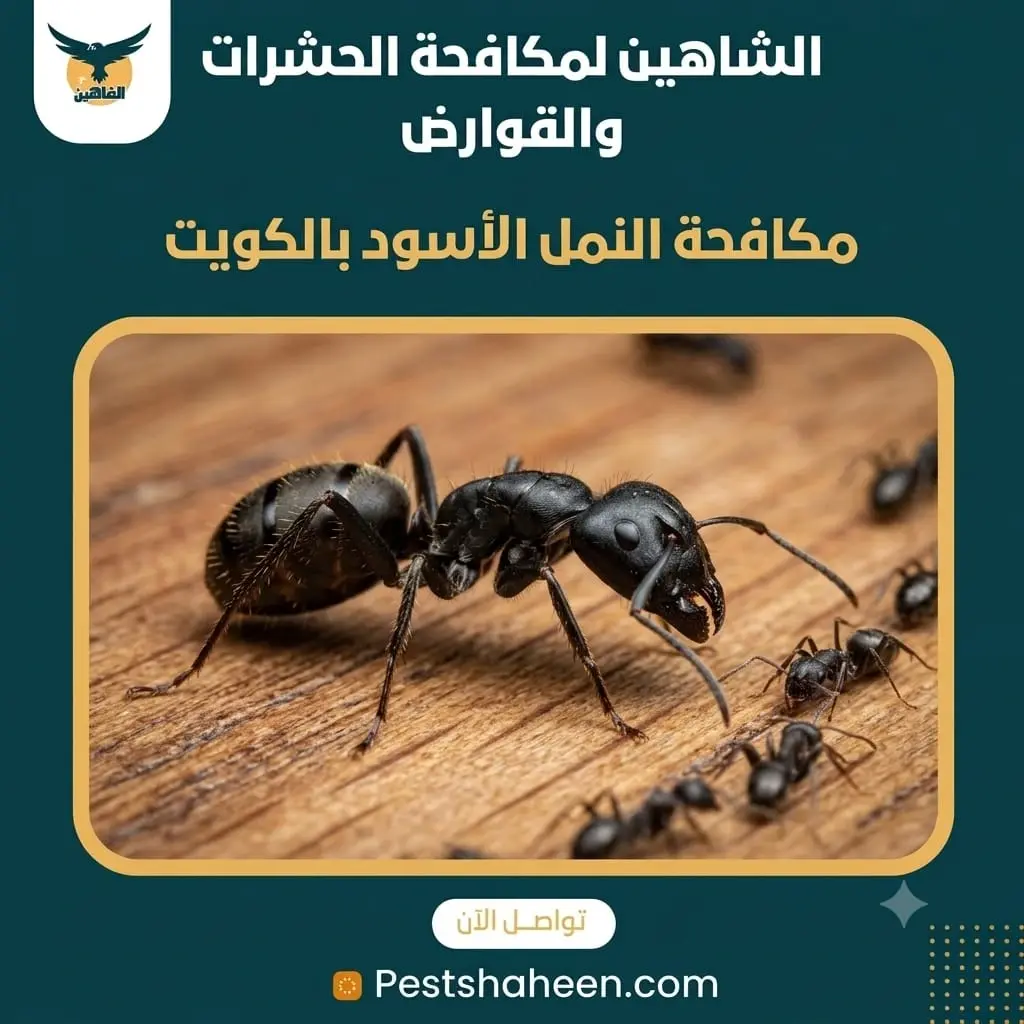
Finding small black ants in the home does not automatically mean the property is poorly cleaned. Even a very tidy home can provide a small source of water, an entry gap, or a tiny amount of food that residents may not notice. For this reason, reducing the problem to “the house needs better cleaning” is often too simplistic. Cleaning helps, but it does not fully explain why a stable trail keeps returning from the same hidden opening every day.
The location of the activity provides valuable clues. If the ants are concentrated around the kitchen, food and moisture become some of the first things to assess. If they appear in the bathroom or close to plumbing, damp areas and gaps around pipes become more important. If the trail begins at an exterior door or a low window, the surrounding outdoor area may be connected to the activity.
Timing also matters. Some homeowners notice ants early in the morning after the kitchen has been quiet overnight, while others see stronger activity after cooking or after food has been left exposed. These details can help identify whether the workers are following a reliable source or becoming active during particular periods.
Another important point is whether the trail remains stable or constantly changes. A consistent route between two points gives a clearer picture of movement. Scattered trails appearing after heavy household spraying may mean the activity has been disturbed and requires a period of observation before more treatment is applied.
At Al Shaheen, we treat ant activity inside the home as useful information that needs to be understood rather than as something that should simply disappear as fast as possible. The more accurately the pattern is recorded, the easier it becomes to narrow down the likely colony area.
-
Ant location is linked with food moisture and possible entry points because the place where activity appears helps narrow down the search for the colony
-
Residents are asked when activity is strongest and whether it increases after cooking cleaning or at particular times because these details can help explain the movement pattern
-
Ants can appear in a very clean home when the attraction is moisture a structural gap or an outdoor entry route rather than food residue alone
-
A stable trail and a trail that changes after household pesticide use provide different information so the movement pattern should be recorded before deciding on the next treatment step
Treating Black Ants in the Home
Treating black ants in the home depends more on the inspection findings than on one fixed product. Activity clearly limited to an exterior entry point requires a different plan from ants disappearing inside a kitchen void or appearing across several rooms.
Treatment may combine reducing food and moisture sources with localized application, suitable bait or gel, and treatment around outdoor entry points when necessary. Not every method needs to be used in every property because using more treatment without a reason does not automatically make the service stronger.
The timing of sealing gaps is also important. If an opening is confirmed as an active route, it is often better to bring the activity under control first and then seal it at the appropriate stage rather than closing it immediately and forcing the ants to search for another route inside the wall.
-
The treatment method is chosen after determining whether the activity is mainly internal or external instead of using the same product for every black ant problem
-
Food and moisture sources are managed alongside treatment because continued access can keep attracting workers even after activity begins to decrease
-
Entry gaps are sealed at the correct stage after the movement pattern has been understood so ants are not pushed toward alternative routes that are harder to track
-
Treatment is reviewed according to how activity changes over the appropriate period instead of immediately increasing pesticide use when a few workers are still seen after the first application
Detecting a Black Ant Colony

The goal of detecting a black ant colony is not always to physically see the nest. A colony may be inside a narrow structural gap, within a wall void, beneath flooring, or outside the property under soil. In many cases, the practical objective is to narrow down the source area closely enough to direct treatment accurately.
The process starts with worker trails. We observe where ants enter, where they disappear, and whether more than one route leads back to the same edge, crack, or opening. The surrounding area is then checked for conditions that may support the colony, including moisture, shelter, or a connection to the outside.
If ants disappear behind a kitchen unit, that does not automatically mean the nest is directly behind that unit. However, it narrows the search area and provides a far more useful starting point than spraying every exposed surface.
-
Worker movement is used as evidence to identify the likely colony area instead of assuming that the nest must be visible before effective treatment can begin
-
When several trails disappear into the same gap or structural opening that location becomes a higher priority during inspection and treatment planning
-
The trail is connected with the outside environment when the point of disappearance is close to an exterior wall or entrance because the colony may actually be outside the property
-
Walls and finishes should not be opened based on guesswork because most infestations can be assessed and treated strategically before any disruptive work is considered
Identifying a Black Ant Nest
Identifying a black ant nest requires combining several clues instead of assuming that the nest is where worker ants are feeding. If ants gather around sugar, that is a feeding area and not necessarily the nest. If they disappear beneath a skirting board, the gap may only be one entrance into a much longer hidden route.
A technician watches the direction of travel in both directions, compares several active points, and checks whether the trails appear to meet or lead toward the same general area. In villas, activity may connect the garden with the interior. In apartments, utility openings and shared service voids may play a larger role.
Hidden nests are completely normal in ant infestations, so direct visual access is not always necessary. The professional objective is to identify the source area accurately enough to make a sensible treatment decision.
-
Feeding points entry points and the likely nest location are treated as three different things because they can all be located in completely different parts of the property
-
Comparing several trails helps determine whether the activity is connected to one source or whether several colonies or entry routes may be involved
-
Property type is taken into account because villas have stronger connections with soil and gardens while apartments may be more affected by utility voids and internal building routes
-
Narrowing the likely nest area to a specific zone can be enough to guide treatment effectively even when the nest itself cannot be seen directly
Controlling Black Ant Trails

Controlling black ant trails begins by understanding the route before wiping it away. The line of ants moving across a counter or wall is not a random gathering. It is a path used by workers travelling between resources and the colony.
One common mistake is spraying the entire trail every time it appears without checking where it begins and ends. This may hide the activity temporarily, but it does not explain where the ants are coming from or where they are going.
Professional treatment focuses on the most important points along the route and monitors whether activity decreases or shifts. If the trail changes after treatment, this does not automatically mean the service has failed. The change itself can provide useful information about the colony direction or an alternative entry point.
-
Both ends of the trail are observed before cleaning so the starting point and destination can be understood instead of focusing only on the middle section that happens to be visible
-
Trails that return at the same time and place are considered more significant than isolated ant sightings because they indicate organized movement
-
A trail that shifts after treatment is recorded and assessed rather than immediately spraying the new location without understanding why the movement changed
-
Trail control uses the route as evidence to help locate the source and reduce colony-related activity instead of simply removing the line from the customer’s view
Spraying Small Black Ants
Spraying small black ants can be suitable in certain situations, but it is not automatically the only or best solution. Direct spraying may be useful for specific treatment points or certain outdoor activity, but applying pesticide only to visible workers may create an immediate visual result without having enough impact on the actual source.
Kitchen treatment requires even greater care because surfaces used for food preparation should not receive unnecessary pesticide application. If the movement pattern allows another method to carry treatment more effectively toward the colony, that option may make more sense.
Applying several different sprays around the same trail can also change ant behavior and make the infestation harder to read. Every application should therefore have a clear purpose.
-
Spraying is used when it suits the infestation location and activity pattern rather than simply because an immediate visible result is desired
-
Food preparation surfaces are avoided when there is no professional reason to treat them and attention is directed toward cracks edges and activity points instead
-
Spraying may be combined with other methods when the infestation benefits from a mixed approach but unnecessary repeat applications are avoided
-
Continued activity after spraying should lead to reassessment of worker movement and the likely colony location rather than assuming that the answer is simply more pesticide
Why Small Black Ants Spread Through the Home

Understanding the reason small black ants spread through the home prevents every sighting from being treated as a separate problem. The cause may be a constant food source, water or moisture, weather changes, a colony close to the building, or new openings created during maintenance or renovation.
Sometimes activity starts in one small area and then expands because workers discover additional food sources inside the property. In other cases, the apparent spread may happen because repeated use of household products has disrupted the original route and pushed workers toward new paths.
It is important not to connect spread with poor cleaning alone. A very clean home can still experience ant activity because of an exterior opening, hidden moisture, or a small leak behind a cabinet that residents cannot see.
-
Food moisture and entry routes are investigated as primary causes rather than assuming that ants are direct evidence of poor cleaning
-
Maintenance work appliance movement and kitchen renovation can expose new voids and alter existing ant routes inside the property
-
Increased activity after a quiet period should lead to a review of what has changed in the environment rather than automatically repeating the previous treatment
-
Identifying the cause helps determine the right preventive step after the colony is controlled so the same conditions are less likely to support another infestation
Eliminating a Black Ant Colony
The idea of eliminating a black ant colony needs to be realistic and based on how the infestation actually behaves. The professional objective is to control or substantially reduce colony activity until the connected trails stop returning while also addressing the factors that support entry and attraction. Results cannot always be judged during the first hour because workers that were already outside the colony may continue moving for some time depending on the treatment method.
In some cases, colony-directed treatment is more effective than directly spraying workers because the aim is to influence the source rather than only the ants that are currently visible. When the source is outdoors, managing the perimeter and entry routes may become part of the control plan.
At Al Shaheen, success is assessed by how movement changes, whether established trails disappear, and whether new routes stop forming. We do not rely on the simple statement that the area was sprayed and the ants disappeared.
-
Colony control is planned around worker trails activity locations and attraction sources instead of using one identical program for every small black ant infestation
-
The selected treatment is given enough time to work according to the method being used instead of disrupting the plan by adding different household products every day
-
A gradual reduction in worker numbers followed by the disappearance of established trails is a stronger sign of progress than the immediate death of a group of ants after application
-
Once control is achieved gaps moisture issues and storage conditions are addressed according to the cause of the infestation so the same environment is less likely to support another colony
Conclusion
Small black ants can look like a minor issue because of their size and narrow trails, but the real challenge is finding out where they are coming from and where the workers return after collecting food. That is why small black ant control in Kuwait and colony identification requires more careful observation than simply spraying the visible trail.
At Al Shaheen, we begin with the movement pattern. We check food and moisture sources, inspect entry points, compare activity across different areas, and then narrow down the most likely colony location. We do not rely on color alone to identify the species, and we do not treat temporary disappearance of worker ants as enough evidence that the problem has been solved.
If the activity is internal, the priority is to address the voids or routes connected to the likely colony using the most suitable method. If the source is outside, treatment is linked with entry points and the surrounding area instead of repeatedly spraying indoor surfaces. After control is achieved, the conditions that encouraged the activity in the first place, such as moisture, exposed food, or structural gaps, should also be addressed.
The strongest result is not simply seeing no ants today. The stronger result is when the established trail disappears and no replacement trail appears a few days later because the treatment has reached the source of the activity instead of chasing workers one by one.
Frequently Asked Questions
Are all small black ants the same species?
No. Color, size, and appearance alone are not always enough to identify an ant species accurately because several species can look very similar. Activity location, movement patterns, behavior, and the surrounding environment should also be considered before deciding on the treatment method.
How can I tell if there is a colony inside my home?
Repeated trails, worker ants appearing every day from an internal opening far from exterior doors, and activity in several connected areas can all suggest that an indoor colony may be present. However, the source still needs to be assessed properly before a conclusion is made.
Why do black ants move somewhere else after spraying?
Spraying or aggressive cleaning can disrupt the route the ants were using and cause workers to find another path. A new trail nearby does not necessarily mean there is a second colony. It may simply be a different route connected to the same source.
Do you have to see the nest to treat it?
Not always. Many ant nests are hidden inside structural voids or beneath soil and cannot be seen directly. Tracking worker movement and narrowing down the likely colony area may be enough to choose an effective treatment without opening walls or damaging finishes.
Is spraying better than bait for small black ants?
There is no single method that is best for every infestation. The right choice depends on the activity pattern, likely colony location, and surrounding environment. Some cases may benefit more from direct treatment, while others may respond better to bait or gel.
Does having black ants mean the home is dirty?
No. Cleaning plays an important role, but it is not the only factor. Ants can enter a clean property because of moisture, a utility opening, an exterior gap, or a colony close to the building.
When does a small black ant problem become serious?
The infestation deserves closer attention when ants appear in several rooms, trails return every day, activity comes back after repeated household treatments, or ants start emerging from several points inside the property.
Should I seal the opening where the ants are coming from immediately?
Not always. It is usually better to understand whether that opening is part of the main route and bring the activity under control first. Sealing too early may redirect workers toward another route without affecting the colony.
What affects the cost of small black ant control?
The spread of the activity, number of affected areas, difficulty of locating the colony, property type, whether indoor and outdoor activity are both involved, and the required treatment method can all affect the cost.
How do I know the black ant colony has been controlled?
A consistent reduction in worker numbers, disappearance of the main trails, and no new routes appearing around the suspected source during the monitoring period are stronger indicators than simply seeing no ants immediately after the first treatment.