Hospital Pest Control Contracts in Kuwait with Follow-Up
Hospitals require a more precise pest management system than most other facilities because they operate continuously and include patients, staff, kitchens, storage rooms, utility areas, waste zones, and multiple entrances. For that reason, a hospital pest control contract in Kuwait should not be limited to a fixed spraying schedule. It should be a structured program based on inspection, recording pest reports, monitoring sensitive points, and correcting the cause before the same problem returns. Cockroaches may be associated with kitchens or drains, rodents may take advantage of loading and utility areas, and insects may enter through doors or with incoming materials. A stronger plan reduces unnecessary treatment, coordinates work with facility management, maintenance, and cleaning teams, and considers the nature of every department before any treatment is carried out.
Hospital Pest Control Contract in Kuwait
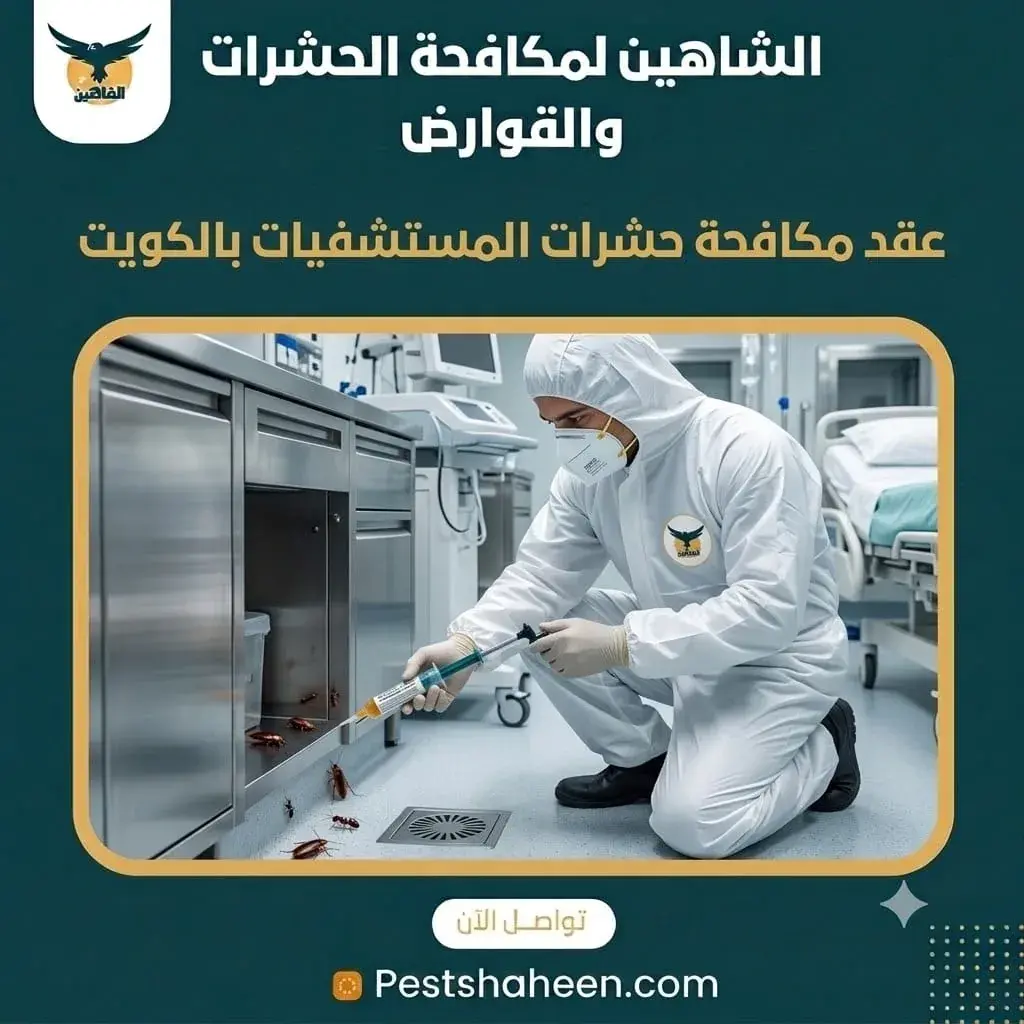
A hospital pest control contract in Kuwait should be built around a clear division of the facility because a hospital is not one single area that can be treated in exactly the same way. It may include patient departments, clinics, offices, kitchens, warehouses, utility rooms, loading zones, waste areas, and outdoor spaces, and each section has different risks and requires an inspection approach suitable for how it is used.
A good contract begins by identifying in detail which areas are included instead of simply stating that the hospital as a whole is covered. If there is more than one building, wing, storage room, or kitchen, the agreement should clearly explain whether all these locations are included within the service scope. The pest categories being monitored should also be defined, such as cockroaches, rodents, flying insects, or any recurring pest activity associated with the facility.
Another important point is that the contract should not depend only on fixed scheduled visits. If a pest report appears between appointments, there should be a clear procedure for assessment and follow-up according to the importance of the location and the nature of the activity instead of automatically waiting for the next scheduled visit.
Reports are also an essential part of the contract. Every visit should ideally record where the activity was found, the type of sign observed, what action was taken, and whether maintenance or cleaning teams need to complete any corrective work. Over time, this allows management to see whether the same problem keeps returning in one location or whether the situation is genuinely improving.
Any treatment should also be organized according to hospital operations and the nature of the department involved. Not every area can be temporarily restricted in the same way, and general treatment should not be carried out around sensitive locations without proper coordination.
• A suitable hospital contract identifies the departments and kitchens and storage rooms and utility areas and external locations included so coverage is clear and sensitive points are not unintentionally left outside the monitoring program
• A pest report appearing between scheduled visits needs a clear assessment and follow-up procedure according to its location and nature instead of automatically being postponed until the next routine appointment
• Detailed reporting helps management connect pest activity with cleaning or maintenance or storage problems and turns pest control into an ongoing management program rather than a separate spraying visit
Pest Control Company for Hospitals in Kuwait
Choosing a pest control company for hospitals in Kuwait requires greater focus on inspection and coordination than on how quickly spraying can be carried out. A company working in a hospital needs to understand that some departments remain active continuously, some contain sensitive equipment, and certain locations require careful coordination before any intervention so normal facility operations are not unnecessarily affected.
The first step should be to collect information about where the report occurred, when the activity appears, and what type of pest is involved. If cockroaches appear around a kitchen or utility room, the inspection should focus on moisture, drains, gaps, and nearby equipment. If rodents are appearing close to a loading zone, attention should shift toward doors, openings, and the external perimeter. Flying insects around a particular entrance require review of door movement, lighting, and surrounding conditions.
A good company should not assume pesticide application is the first solution in every situation. Sometimes the cause is a leak, opening, accumulated materials, or a storage practice, and correcting that underlying factor may be more important than repeating pesticide treatment.
There should also be clear coordination with hospital management before entering certain areas. If pest activity appears close to equipment, utility lines, or a location that requires technical access, the area should be reached in cooperation with maintenance staff rather than spraying inside equipment indiscriminately.
Documentation is also important. Simply stating that spraying was completed does not provide hospital management with enough information. A better report identifies the location, problem, action taken, and recommendation so the source can be followed between visits.
You can contact Shaheen Pest Control to inquire about services for hospitals in Kuwait and explain the facility size, number of buildings, and locations where pest activity has repeatedly appeared before defining the service scope.
• A suitable hospital pest control company begins by identifying the activity source according to the department and how it is used instead of applying the same procedure to kitchens and utility rooms and storage areas and corridors
• Any pest activity close to equipment or utility lines or sensitive systems requires coordination with maintenance so the source can be accessed without indiscriminate pesticide use inside equipment
• A report that clearly explains the location and action and recommendation gives hospital management a practical basis for follow-up and turns the service from a temporary response into a program that can be reviewed over time
Pest Control Contracts for Private Hospitals

Pest control contracts for private hospitals need an organized structure that allows management to know what is inspected during every visit and what happens when new pest activity appears between scheduled appointments. A private hospital may include several buildings or floors, kitchens, storage rooms, parking areas, and utility sections, so the contract needs to be clear from the beginning to avoid later disagreement about service coverage.
The first important section is the area schedule. The contract should identify which departments are included, how many visits are planned, and how access is arranged for locations that require prior coordination. Some areas may be easy to enter while others may need approval from department management before inspection or treatment.
The included pest categories should also be defined. A contract that only states pest control without further detail may create confusion if a rodent problem or flying insect activity appears and the original agreement covered only selected pest types. It is better to define everything clearly at the beginning.
The way recurring cases are handled is another important point. If the same location reports activity every month, the contract should allow the cause to be reviewed rather than simply repeating the same treatment. The issue may be linked to a drain, door, waste route, or storage area that requires operational correction.
The value of the contract also appears in its reports. A hospital needs records showing the date, location, report type, action taken, and recommendations so pest control can be connected with maintenance, cleaning, and facility management.
For long-term contracts, the plan should be updated whenever facility use changes. If a new department opens, a storage room is relocated, or a kitchen changes location, the monitoring plan should change accordingly. A fixed plan becomes less useful when the operational layout changes.
• A private hospital contract should define buildings and departments and visit frequency and included pest types from the beginning so every party clearly understands its responsibilities and disagreements do not appear after service begins
• Repeated activity in the same location should trigger review of the operational or structural cause instead of repeating the same treatment every time without changing the plan
• Updating the contract scope whenever a new department opens or an area changes use keeps pest monitoring connected to the hospital's actual operation rather than an outdated site plan
Rodent Control in Hospital Facilities
Rodent control in hospital facilities requires treating the site as one connected system because a mouse or rat may appear inside a storage room or utility area while the actual entry point is at a loading zone, rear door, gap around utility lines, or external area close to waste. Placing a trap where the rodent was seen is therefore not enough if the route allowing entry remains open.
Inspection begins with actual signs such as droppings, gnaw marks, damaged packages, and movement routes close to walls. These signs are then connected to doors, utility areas, openings around pipes and cables, and the external building perimeter. If signs continue along one repeated route, this gives a stronger indication of movement direction than a single sighting.
Rodent droppings should be handled using an appropriate cleaning procedure and should not be dry swept or removed with an ordinary vacuum cleaner. Nearby materials or packages suspected of gnawing or contamination should also be evaluated rather than simply wiped on the outside and returned to use.
Monitoring devices also need carefully selected locations because hospitals contain continuous movement of staff, patients, trolleys, and equipment. The aim is to place them where rodent movement is likely without obstructing normal activity or creating an unsuitable situation for the area.
In a practical case, signs may continue appearing near the same rear service door even after several mice have been removed. In that situation, increasing the number of traps does not solve the underlying issue if a gap beneath the door still allows entry. Inspecting and correcting the entrance and monitoring the area afterward becomes more important than trapping alone.
• Rodent control inside hospitals begins by tracing droppings and gnaw marks and connecting them with doors and openings and utility areas so the entry route can be identified instead of placing traps only where the animal was seen
• Any package showing gnawing or contamination should be isolated and evaluated according to its nature rather than automatically returned to use after cleaning the outer surface
• Continuing rodent activity after some animals are removed means entry points and attraction sources need another review because preventing new entry is the foundation of reducing recurrence
Cockroach Control in Hospital Kitchens

Cockroach control in hospital kitchens requires careful inspection because kitchens combine food, water, warmth, equipment, washing areas, and storage, and these locations can provide suitable conditions for cockroaches when cleaning, maintenance, or storage problems develop. For that reason, the problem should not be handled by spraying the entire kitchen but by identifying where the activity begins.
If cockroaches appear around the washing area, drains, leaks, spaces beneath sinks, and moisture-prone corners should be inspected. If activity is close to refrigerators or cooking equipment, the spaces behind equipment, surrounding floors, and locations where small residues may accumulate outside routine cleaning should be reviewed.
Dry food storage inside the kitchen also needs attention because stacked cartons and bags may conceal activity that is not obvious during normal work. Organizing stock so floors and walls remain accessible makes it easier to find signs before the problem spreads.
One mistake is carrying out general spraying over surfaces, near exposed food, or inside equipment openings. Any treatment should be directed only toward suitable locations while food, utensils, and preparation surfaces are protected and the product instructions are followed.
In a practical case, cockroaches may appear every morning behind the same refrigerator despite daily cleaning. The equipment should then be moved with appropriate coordination so the rear area, connections, and moisture can be inspected instead of repeatedly spraying from the front.
Controlling the problem requires cooperation between pest control, cleaning, and maintenance teams. If there is a continuing leak or drain problem, pesticide treatment alone will not prevent recurrence.
• Cockroach control in hospital kitchens begins by inspecting drains and moisture and areas behind equipment and storage points because activity often begins at a specific location rather than across the entire kitchen
• Food and utensils and preparation surfaces should be protected from unnecessary treatment and pesticide application should be directed only toward appropriate locations according to actual need and product instructions
• Repeated cockroach activity near the same equipment or drain requires another review of cleaning and maintenance and leaks instead of increasing pesticide use without correcting the underlying cause
Pest Management Program for Healthcare Facilities
A pest management program for healthcare facilities is stronger when it is based on prevention, monitoring, and documentation rather than corrective visits alone. Hospitals operate continuously and include departments with different functions, so the program needs a clear map of areas and monitoring schedules that reflect the level of risk in each part of the facility.
The process begins by dividing the facility into areas such as kitchens, storage rooms, utility rooms, offices, corridors, waste sections, and outdoor spaces. Monitoring points, previous pest reports, and locations with repeated activity can then be identified.
The program should include clear responsibilities. The pest control company is responsible for inspection, treatment, and documentation within its service scope. Maintenance teams handle openings, leaks, doors, and technical problems, while cleaning management deals with waste and sanitation. When each party understands its role, the result is stronger than relying on spraying for everything.
The program also needs routine review of results. If pest activity decreases in one area but begins in another, the plan should be adjusted instead of maintaining the same visit distribution. If a problem repeatedly appears near one door, that location should receive higher inspection priority and the operational cause should be reviewed.
Keeping a record of pest reports and recommendations is important so the facility has a clear history of each issue. Depending only on memory or verbal communication makes repeated patterns more difficult to identify.
In a large healthcare facility, different monitoring levels may be assigned according to how sensitive each area is and how it is used rather than giving every department exactly the same visit frequency and procedures.
• A healthcare pest management program connects inspection and monitoring and cleaning and maintenance and documentation so the source of activity is addressed instead of relying only on corrective treatment visits
• Dividing the hospital according to how each area is used helps distribute monitoring more accurately and prevents identical procedures from being applied to locations that differ in function and need
• Reviewing records and results regularly allows the program to be adjusted when activity changes or a new problem appears and keeps the plan connected to actual conditions within the facility
Pest Control Follow-Up in Hospitals
Pest control follow-up in hospitals is what shows whether treatment actually succeeded or only reduced the problem temporarily. After every intervention, the original activity point should be reviewed and compared with its previous condition instead of assuming the work ended once spraying or monitoring devices were placed.
Follow-up begins with locations that previously had the highest number of reports. If cockroaches were appearing around a kitchen drain, the same location should be reviewed and maintenance recommendations checked. If the problem was near a loading door, door closure, gaps, and movement around the area should be reassessed.
It is important to distinguish between not seeing insects and actually removing the cause. There may be no sightings for several days while the same leak or opening still exists. Follow-up should therefore include corrective recommendations rather than only searching for visible pests.
The timing of reports should also be compared. If activity previously appeared at night and daytime sightings disappeared after treatment while after-hours observations continue, this information should be recorded and reviewed.
When the same department reports repeated activity, earlier reports should be checked to identify what changed and which recommendations were not completed. The problem may be connected to an older recommendation such as repairing a door, removing accumulated materials, or correcting a leak.
Organized follow-up reduces guesswork and allows hospital management to determine whether the plan is working or needs adjustment instead of repeating the same action without measurement.
• Follow-up after treatment should compare previous and current pest activity and verify whether maintenance or cleaning recommendations were actually completed
• A short period without pest sightings is not enough to prove the problem is resolved if the underlying cause such as a leak or opening still exists
• Reviewing earlier reports when activity returns helps determine whether the problem came back from the same source or developed because of a new factor within the department
Inspecting Pest Entry Points in Hospitals
Inspecting pest entry points in hospitals is one of the most important preventive measures because insects do not necessarily originate inside the building. They may enter through exterior doors, loading zones, spaces around pipes and cables, or with cartons and supplies delivered to the facility.
Doors that open frequently require particular attention, especially rear entrances, service doors, and loading doors. Edges, lower gaps, door closure, and any opening that allows insects to enter from outside should be inspected.
Utility penetrations are also important because pipes and cables move between different parts of the building and may leave small spaces that insects can use. These locations should be inspected in coordination with maintenance so any sealing or repair does not interfere with building services.
Receiving areas are another important point. Cartons and materials entering the hospital may carry insects or conceal them within packaging. Inspecting damaged packages before they are distributed into storage rooms reduces the chance of carrying the problem deeper into the facility.
External lighting around certain entrances may also attract flying insects. If reports increase in the evening around a specific door, the outside environment and door movement should be reviewed instead of simply spraying the internal corridor.
For example, if small insects repeatedly appear around the same window or ventilation opening, both the inside and outside should be inspected while screens and edges are reviewed rather than assuming the source is inside the room.
• Entry-point inspection should include doors and loading areas and utility penetrations and incoming packages because pests may enter hospitals through several routes and may not originate in the department where they are first observed
• Gaps around pipes and cables should be corrected in coordination with maintenance so the entry route is closed without affecting technical services within the building
• Repeated activity around one door or window requires review of closure and lighting and external conditions instead of repeating internal spraying without correcting the entry point
Hospital Pest Control Contract Prices
Hospital pest control contract prices vary according to facility size, number of buildings, departments, storage rooms, kitchens, external areas, included pest categories, and the number of required visits. There is no single price that applies to every hospital because the work scope can vary significantly from one site to another.
A hospital with one building, a small kitchen, and limited utility areas is different from a large facility containing several wings, kitchens, warehouses, loading zones, parking areas, and outdoor spaces. Repeated rodent activity also changes the scope compared with limited insect activity in one location.
The number of visits matters, but it is not the only factor. You also need to know what happens during every visit, whether reporting is included, how pest reports between scheduled appointments are handled, and whether external areas are included or charged separately.
Some locations may also require special coordination before access, which can affect the amount of time and planning required. It is therefore better to provide clear information about the facility rather than asking for one general price without details.
When comparing quotations, the service scope matters more than the number alone. A cheaper offer that excludes external storage, rodents, or additional visits may provide less value than a broader contract even if its final price is lower.
A fixed price should not be provided without sufficient information or site assessment because the real cost depends on actual work requirements and how the hospital operates.
• Contract price depends on the number of buildings and departments and pest categories and visit frequency and covered areas so accurate facility information is important before pricing
• Comparing quotations should include reporting and additional pest reports and external areas and rodent coverage rather than only visit numbers and the final contract price
• A large hospital or one with repeated activity in several areas requires a different monitoring scope from a facility where the problem is limited to one location
Hospital Pest Control Follow-Up Reports
Hospital pest control follow-up reports are operational tools rather than simple documents proving that a visit took place. A useful report helps hospital management understand what happened at the site, what was completed, and which recommendations require follow-up by maintenance, cleaning, or department management.
The report should usually begin with the visit date, the areas inspected, and the type of pest activity recorded. It should then explain what action was taken, such as inspecting a particular point, treating a specific location, or reviewing a monitoring device.
Observations requiring another department to take action should also be recorded. If the technician notices a leak, opening, poorly closing door, or accumulated cartons, the observation should be written clearly so management can assign it to the responsible team.
The greatest value appears when reports are compared over time. If the same location records activity four times within a short period, this shows that the underlying cause may not have been corrected or the plan needs adjustment. If activity gradually decreases, that provides evidence that the corrective actions are moving in the right direction.
Reports do not need unnecessary filler, but they do need useful and actionable information. Writing that spraying was completed is not enough if the report does not explain where, why, what was observed, and what needs to happen next.
In larger hospitals, it is also useful to connect reports with a site map or consistent area numbering so location names do not change from one visit to another and records remain easy to compare.
• A useful report identifies the location and pest activity and action taken and required recommendation so management can follow the issue between visits instead of simply documenting that a service was performed
• Comparing reports over time helps reveal locations where pest activity repeatedly appears and shows whether the underlying cause has been corrected or remains unresolved
• Standardized area names and numbering make records easier to review and reduce confusion especially in hospitals containing several buildings or wings
Conclusion
A hospital pest control contract in Kuwait requires a clear system that combines inspection, monitoring, documentation, and coordination with maintenance, cleaning, and facility management. Hospitals are not suitable for one general spraying approach across every department because kitchens, storage rooms, utility areas, loading zones, and entrances all have different pest sources and require different responses.
Rodents require route tracing, entry-point sealing, and review of external areas, while cockroaches require inspection of kitchens, drains, and moisture. Other insects require evaluation of entry points and material movement. Follow-up reports are what show whether the plan is actually working or needs adjustment.
You can contact Shaheen Pest Control to inquire about a hospital pest control contract in Kuwait and explain the facility size, number of buildings, departments, and locations where reports repeatedly occur. The strongest plan is one that corrects the cause, monitors the result, and reduces unnecessary intervention according to the nature of every location.
Frequently Asked Questions
Does a hospital pest control contract need to include every department?
Not necessarily with the same monitoring method, but the contract scope should be clear and specify the departments, storage rooms, kitchens, and external areas included in the service.
Does every pest report inside a hospital require spraying?
No. The report should first be inspected and the source identified because the problem may be an opening, leak, incoming material, or one specific area and may not require general spraying.
How are rodents managed inside hospital facilities?
Droppings, gnaw marks, and entry routes are traced while doors, openings, and external areas are reviewed and monitoring devices are placed in suitable locations according to the nature of the facility.
What are the main causes of cockroach activity in hospital kitchens?
Moisture, drains, leaks, gaps behind equipment, food residues, and storage areas are all important points to inspect when cockroach activity continues.
Are reports important in a hospital pest control contract?
Yes. Reports identify the activity location, action taken, and recommendations and help management compare conditions from one visit to another instead of depending on memory or verbal communication.
Should external areas be included in a hospital pest management program?
They should be evaluated because they may become entry sources for rodents and insects, especially around loading areas, waste zones, and rear entrances.
How much do hospital pest control contracts cost?
There is no fixed price because the cost depends on facility size, number of buildings and departments, pest categories, visit frequency, covered areas, and monitoring scope.
Is a routine visit enough when a pest report appears between scheduled appointments?
Not always. A strong contract should explain how reports between scheduled visits are handled so they can be evaluated according to their location and nature rather than simply waiting without review.
How can we tell whether the pest control plan is working?
By comparing pest reports, follow-up records, and activity points over time and checking whether underlying causes such as openings or leaks have been corrected and whether repeated activity is decreasing.
What is the most important element in a hospital pest management program?
The most important element is connecting inspection with the real source of activity and following corrective recommendations with maintenance and cleaning teams while maintaining continuous documentation instead of depending on spraying alone.
 Contact Us on WhatsApp