Safe Pest Control for Nurseries and Daycares in Kuwait
Nurseries require a more careful pest control approach than ordinary places because children constantly touch floors, toys, tables, and other surfaces and spend long periods inside the rooms. For that reason, safe pest control for nurseries and daycares in Kuwait should begin with inspection and identifying the real source of the problem before any spraying is considered. Ants may appear because of small food residues around meal areas, while cockroaches may be linked to moisture, drains, or gaps behind kitchen equipment, and some insects may enter from outdoor play areas. The stronger plan minimizes pesticide use whenever possible and relies first on cleaning, sealing openings, maintenance, and targeted treatment only when necessary, while following product instructions and the required re-entry period before children return.
Pest Control for Nurseries in Kuwait
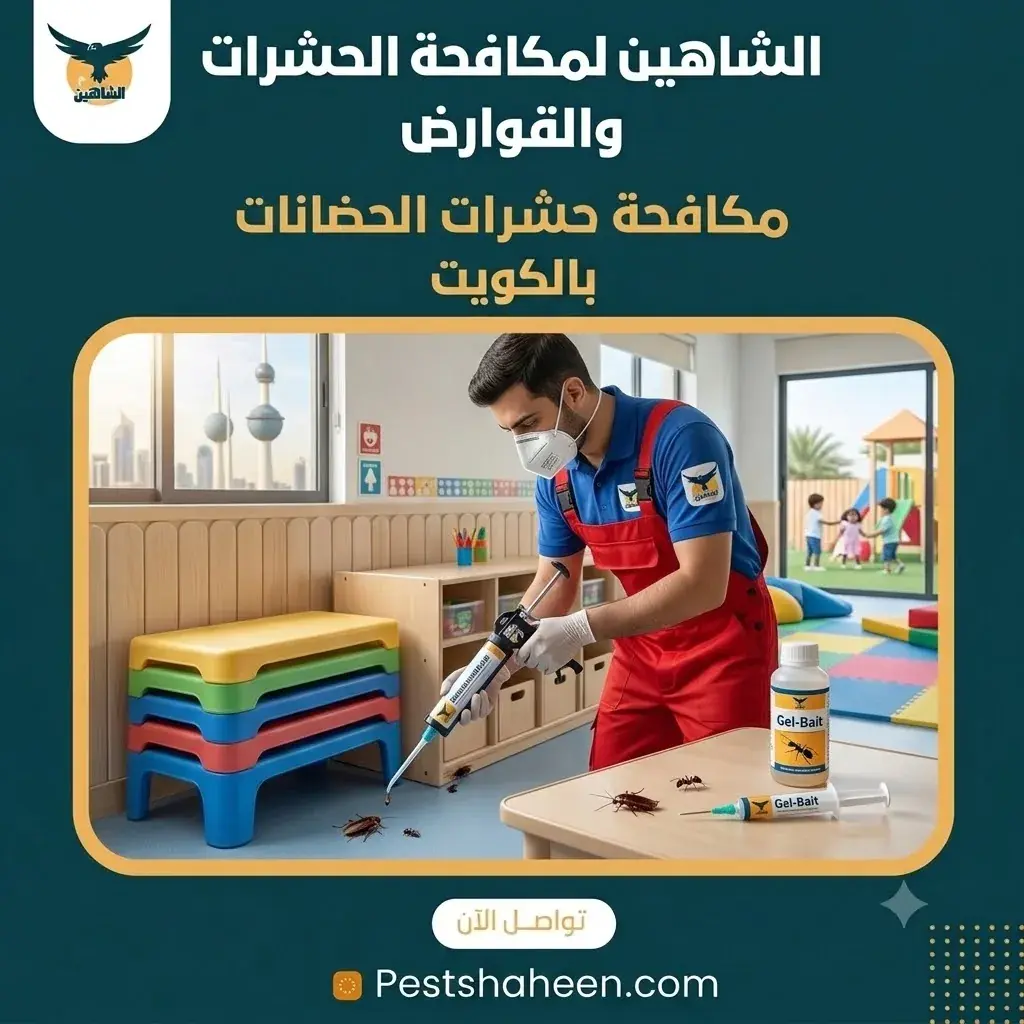
Pest control for nurseries in Kuwait should begin with the understanding that children interact with the environment differently from adults. A child may play on the floor, touch walls and toys, and then touch their face or mouth. For that reason, a nursery should not be treated like an office or warehouse where general spraying may be carried out throughout the rooms simply because one insect was found in one area.
The first step is to divide the nursery according to how each space is used. Sleeping rooms need a different inspection approach from meal areas, playrooms, restrooms, and outdoor spaces. If ants appear near a dining table, the trail and food residues should be reviewed and openings inspected instead of spraying the whole room. If cockroaches appear near a sink or restroom, moisture, drains, and surrounding gaps should be examined.
It is also extremely important to prevent unnecessary treatment of toys, mattresses, children's equipment, and eating areas. If pesticide use is required at one specific point, the area should be prepared according to the product instructions, items that need protection should be removed, and children should not return until the required re-entry period has passed.
In a practical situation, nursery management may notice small insects every morning beneath one particular toy shelf. Instead of spraying the entire floor, the shelf should be moved and the area behind it inspected for a gap, hidden food residue, or moisture. This approach helps identify the cause and reduces the need for broad treatment.
It is also useful for the nursery to maintain a simple pest report log showing the room, time, and pest type when possible because repeated activity in the same place may indicate a cause that needs correction rather than another spraying visit.
• Nursery pest control begins by identifying the affected room and activity source and understanding how the area is used so treatment remains limited to the required point and toys or mattresses or surfaces used by children are not exposed unnecessarily
• Every pest report inside a nursery should lead to inspection of food sources or moisture or openings because removing the cause reduces recurring activity more effectively than depending on general spraying throughout the rooms
• Children should return to a treated area only according to the product instructions and any ventilation or cleaning requirements and the stated re-entry period rather than according to an approximate waiting time chosen by the nursery
Pest Control Company for Children's Nurseries
Choosing a pest control company for children's nurseries requires more attention to the way the company works than simply comparing price or response speed. A suitable provider should understand that the presence of young children changes the inspection and treatment process completely and that the goal is not only to eliminate the pest but also to reduce unnecessary exposure of children, equipment, and surfaces.
The first questions should focus on where the problem has appeared, the types of rooms within the nursery, and the daily activity in those spaces. Is the pest report coming from a playroom, a small kitchen, a restroom, or an outdoor area? Each location has different potential sources and the nursery should not be treated as one single area.
A good company should not begin with general spraying before inspection. If ants are entering through a gap near a window, sealing the route and removing the attraction source may be more important than spraying the whole room. If cockroaches are around a drain, moisture and surrounding openings should be inspected. If flying insects are entering from an outdoor door, the solution may be more connected to door movement and the outside environment than to the children's room floor.
The company should also clearly explain what needs to be removed or covered before treatment, how long the area needs to remain vacant, and what should be completed before children return. General statements such as spraying now and returning after two hours are not enough unless the timing is based on the actual product instructions and the way it was applied.
You can contact Shaheen Pest Control to inquire about nursery pest control services in Kuwait and explain the number of rooms, where activity has appeared, and the nature of the problem before the service scope is defined.
• A suitable nursery pest control company begins with inspection and determines whether the problem requires cleaning or sealing an opening or maintenance or targeted treatment instead of assuming comprehensive spraying is the first solution in every case
• Nursery management should receive clear instructions before treatment about room preparation and protection of toys and equipment and the required re-entry time so everyone understands exactly what needs to be done
• Choosing a company that understands nursery environments helps reduce unnecessary treatment in children's play areas and keeps the focus on the actual source of the problem instead of expanding spraying simply as a precaution
Insect Spraying in Nurseries in Kuwait
Insect spraying in nurseries in Kuwait requires a more carefully considered decision than in many other locations because children have direct contact with floors, tables, toys, and sleeping areas. For that reason, spraying should not be the automatic first response whenever an insect appears. It should only be used when inspection confirms that pesticide treatment is actually required and the method is appropriate for that location.
Before any spraying takes place, the exact target area should be identified. If activity is behind a cabinet or around a utility opening, there is no reason to treat the center of the room or areas where children play. Exposed toys, mattresses, food utensils, and any item that could be affected by spray or residues should be moved or protected according to the product requirements and treatment method.
Treatment should also be carried out when children are not present whenever the application instructions require the area to be vacated. After treatment, the required re-entry period, ventilation instructions, and cleaning requirements should be followed. The disappearance of odor is not enough to prove the area is ready for use because readiness depends on the product instructions rather than smell.
One major mistake is repeatedly spraying the same location without understanding why insects keep returning. If cockroaches repeatedly appear around a small sink, leaks, moisture, and openings should be reviewed. If ants return beneath the same table, the food source and movement route should be investigated instead of simply increasing the amount of pesticide.
For example, limited activity may appear around the outdoor door at the end of the day. In that case, the door frame, edges, and possible external source should be inspected before the entire playroom is sprayed. The more targeted the treatment is, the more precise the pest control becomes and the less unnecessary exposure occurs.
• Nursery spraying should be the final step after inspection confirms that pesticide treatment is actually necessary and it should be directed only toward the target point rather than spreading treatment throughout spaces used by children without a clear need
• Toys and mattresses and food utensils and surfaces frequently touched by children need protection and preparation before treatment according to product instructions so they are not exposed to substances that do not need to reach them
• Repeated pest activity after spraying requires another inspection of leaks and openings and food sources and moisture because increasing pesticide use without correcting the cause may allow the problem to return
Ant Control in Children's Nurseries
Ant control in children's nurseries requires careful observation because ant trails often provide a clear route that can help identify where they are entering and why they selected that area. The problem is not only the ants themselves but also the condition that attracted them indoors, such as spilled juice, a small biscuit crumb, a gap around a window or door, or a nearby moisture source.
The first step is to observe the direction of movement before wiping the trail away. If ants are emerging from beneath a wall edge or beside a window, that point should be identified and inspected from both inside and outside. If the activity is concentrated near the meal table, the entire area should be cleaned and the space beneath the table, drawers, and corners checked for small food residues.
Inside nurseries, children may drop food in places that are not immediately visible, such as underneath play units or behind low cabinets. These locations need regular cleaning because even small residues may continue attracting ants while the rest of the room appears clean.
One mistake is spraying the ant trail directly every time without identifying its source. Visible ants may disappear temporarily, but the activity may return because the original route has not been addressed. The better approach is to identify the entry point, reduce the attraction source, and then apply appropriate treatment only where required.
In a realistic situation, ants may appear every morning beneath the same activity-room window. The window frame, surrounding gaps, and food sources inside the room should be inspected before any broader treatment is considered.
• Observing the direction of ant movement before cleaning the trail helps identify the entry point and attraction source and prevents the same problem from repeating every day without understanding the real cause
• Cleaning areas beneath play units and tables and cabinets is important because even very small food or drink residues may be enough to maintain ant activity inside the nursery
• Ant treatment in nurseries should focus on the trail and source while avoiding children's play areas and surfaces they touch frequently whenever possible
Cockroach Control in Nurseries
Cockroach control in nurseries requires careful inspection of areas that provide moisture, warmth, and hiding places because seeing a cockroach inside a children's room does not necessarily mean the source is located inside that room. The problem may come from a nearby restroom, small kitchen, cleaning room, drain, or gap behind storage units.
Inspection begins with areas containing water or utility lines. Sinks, drains, spaces behind small refrigerators or storage cabinets, and locations where cleaning supplies are kept should be reviewed. If cockroaches are mainly seen after the end of the day or early in the morning, this may indicate that activity becomes more visible when the nursery is quiet.
The waste route and food residues should also be reviewed, especially when the nursery provides snacks or meals. Crumbs, open containers, or waste bins that remain for long periods may provide a continuing attraction source.
One mistake is using a quick aerosol spray inside the room as soon as one cockroach is seen. This may move insects into another area and expose nearby surfaces to unnecessary treatment. The better approach is to record the sighting location, inspect surrounding areas, and then carry out a targeted intervention.
For example, cockroaches may repeatedly appear at the entrance to a restroom next to the children's sleeping room. In that case, the edges, moisture, drain, and gaps between the two spaces should be inspected instead of spraying the entire sleeping area.
• Cockroach activity inside a children's room should lead to inspection of restrooms and water areas and cleaning rooms and nearby spaces before the room itself is considered the source of the infestation
• Regular removal of food residues and organized waste management inside the nursery reduces attraction factors and makes the pest control plan stronger than depending on spraying alone
• Repeated activity at the same point after treatment means the underlying cause such as moisture or an opening or food source needs another review instead of increasing the amount of pesticide used
Pest Control in Children's Playrooms
Pest control in children's playrooms requires special attention because these rooms contain many surfaces that children touch directly, including floors, toys, tables, cushions, and storage shelves. Any plan should therefore begin with the least intrusive approach possible and focus on the real source rather than turning the entire room into a treatment area.
The first places to inspect are beneath play units, behind cabinets, and inside corners that may be difficult to reach during normal daily cleaning. Toy boxes should also be checked, especially when they remain closed for long periods or contain fabric or cardboard materials that may hide small insects.
If insects appear around one particular area, nearby toys should be removed, the location inspected, and the area cleaned before any decision is made about using a treatment product. Not every insect problem requires pesticide because some cases are caused by food crumbs, minor moisture, or entry through a window.
Toys themselves should not be sprayed indiscriminately. If one toy is suspected, it should be isolated, inspected, and cleaned in a manner appropriate for its material rather than exposing all toys to the same treatment.
Room organization also makes a major difference. When toys are stacked in ways that prevent access to the floor and corners, inspection becomes more difficult. Organized toy storage makes early activity easier to detect and improves cleaning efficiency.
In a practical example, small insects may appear beneath an old fabric toy box. The box, its contents, and the area beneath it should be inspected rather than spraying the entire room. If the issue is limited to the box, it can be handled separately.
• Playrooms need inspection behind shelves and beneath boxes and in corners that daily cleaning does not easily reach because pest activity may remain hidden in those locations for a long period
• Toys close to the activity point should be inspected and cleaned according to their material and all toys should not be sprayed simply because one part of the room has a pest problem
• Organizing toy boxes and reducing clutter helps reveal early pest activity and reduces closed spaces where insects can remain hidden without being noticed
Spraying Nurseries Outside Working Hours

Spraying nurseries outside working hours can be suitable in some situations because it reduces the presence of children and staff during treatment. However, choosing a time after closing does not automatically guarantee that the nursery will be ready for use the following day. The decision depends on the product used, the application method, and the required re-entry period stated in the instructions.
Before treatment begins, only the rooms that actually require intervention should be identified. If the problem is located in a utility area or around an external door, there is no need to spray every children's room. Reducing the treatment scope lowers unnecessary exposure and makes preparation and cleaning easier.
Toys, equipment, food items, and mattresses should also be removed or protected according to the location and product instructions. After treatment, any ventilation or cleaning requirements should be completed before the room is put back into normal use.
One mistake is spraying at night and reopening the nursery the next morning without checking the required waiting period. Some products or application methods require a specific amount of time before people return, and this should be part of the plan from the beginning.
When treatment takes place over a weekend, management may have more time for inspection, maintenance, and cleaning, but that still does not mean comprehensive spraying is required in every room. The available time can instead be used to seal openings, repair leaks, and clean concealed areas.
• Choosing a time outside working hours reduces children's presence during treatment but does not replace the need to follow re-entry periods and ventilation and cleaning requirements according to the product instructions
• Limiting treatment to rooms that genuinely need intervention reduces pesticide exposure throughout the nursery and keeps the focus on the actual source instead of applying general spraying as a precaution
• Using weekends or closure periods for maintenance and cleaning and sealing openings often provides a stronger result than depending on spraying alone whenever insects appear
Pest Inspection in Nursery Facilities
Pest inspection in nursery facilities should cover the entire site in an organized way because the problem may begin at a small point that is easy to overlook. A restroom, supply closet, corner behind a small refrigerator, or another concealed location may become the source of activity that later appears inside children's rooms.
Inspection should begin by dividing the nursery into functional areas such as playrooms, sleeping rooms, meal areas, restrooms, small kitchens, storage areas, and outdoor spaces. Each location is then inspected according to how it is used rather than walking through the whole nursery using the same general checklist.
In sleeping rooms, attention should be given to floors, corners, wall edges, and areas behind beds or mattresses. Meal areas require greater focus on food residues, storage, and waste. Restrooms need review of moisture, drains, and leaks.
Doors, windows, and openings around pipes and cables should also be checked because some insects may enter from outside even when internal cleaning is good.
Nursery supervisors and staff can also provide valuable information because they know when insects usually appear and which room receives repeated reports. This information can shorten the inspection process and help connect activity with a specific time or use pattern.
If the problem returns, earlier reports should be reviewed. Repeated activity in the same facility may indicate an unresolved leak, opening, or storage issue rather than a completely new pest problem every time.
• Organized inspection divides the nursery according to how each space is used and allows every area to be reviewed based on its actual risk factors instead of depending on a quick general walkthrough
• Observations from nursery supervisors and staff are important because they can identify the time and locations where insects repeatedly appear and provide details that may not be visible during a short inspection visit
• Repeated activity in the same facility should be compared with earlier reports to determine whether a continuing leak or opening or storage issue exists instead of treating every occurrence as an unrelated new case
Pest Control Prices for Nurseries in Kuwait

Pest control prices for nurseries in Kuwait vary according to the size of the site, number of rooms and facilities, pest type, infestation extent, and the type of service required. A small nursery with a limited ant problem is different from a large nursery with several floors, a kitchen, outdoor areas, sleeping rooms, and repeated cockroach activity.
The treatment method also affects the price. If the problem is limited and the source is clear, the work scope may be smaller than a situation requiring complete inspection and more than one follow-up visit. The presence of rodents or several pest types also changes the assessment.
Another important factor is the number of areas that require preparation before treatment. A playroom filled with toys and mattresses may require more preparation than an empty corridor or a simple utility area.
When requesting a price, it is better to provide the number of rooms, meal areas, restrooms, outdoor spaces, the current problem, and where the activity has appeared. The more accurate the information is, the closer the quotation will be to the real situation.
You should also ask whether the price includes follow-up or only one visit. Some pest problems require another inspection after a period of time to confirm that activity has stopped and has not moved elsewhere.
A fixed price should not be applied to every nursery because every site differs in design, use, and pest activity level. Pricing should be based on the actual service scope.
• Nursery pest control pricing depends on site size and number of rooms and pest type and infestation extent and the required treatment method so detailed information helps produce a more accurate quotation
• A nursery that requires preparation and protection of toys and mattresses and meal areas may have a different work scope from a small site with one limited pest problem
• Asking the company about follow-up and additional visits from the beginning makes the cost clearer and prevents different service offers from being compared only by the price of one visit
Nursery Pest Control with Children's Safety in Mind
Nursery pest control with children's safety in mind means building the entire plan around reducing unnecessary exposure and addressing the cause before using pesticide. Children have greater contact with floors and frequently touched surfaces, so every decision inside the nursery should consider play, sleeping, and eating areas.
The first step is to remove conditions that attract pests, such as food residues, moisture, leaks, and openings. Monitoring and inspection should then be used to identify where activity is actually occurring. If treatment is required, it should be selected according to the location, the nature of the problem, and the product instructions.
Nursery management also has an essential role. Organizing food, emptying waste regularly, cleaning under furniture, checking old toys, and addressing leaks all reduce the chance of pests returning.
After treatment, children should not be returned to the area before all requirements have been completed. If ventilation, cleaning, or a waiting period is required, those instructions should be followed fully.
When activity is very limited, a simple correction such as sealing an opening or removing an attraction source may sometimes be enough without any need for broad spraying.
The point is not that every pesticide is always dangerous, but that its use should have a clear reason, be applied in the correct location, and follow the proper method. The more accurate the inspection is, the smaller and more appropriate the intervention can be.
• Protecting children begins by reducing unnecessary spraying and relying first on cleaning and maintenance and entry-point sealing and identifying the activity source before any pesticide is used
• Play and sleeping and eating areas require the highest level of protection and should be carefully prepared if treatment is required nearby while all product instructions are followed completely
• Successful pest management depends on nursery management cooperating with cleaning and storage and maintenance measures because pest control is not only the responsibility of one treatment visit but an ongoing process that prevents the cause from returning
Conclusion
Safe pest control for nurseries and daycares in Kuwait requires greater emphasis on inspection, prevention, and reducing unnecessary pesticide exposure because children touch floors, toys, and surfaces throughout the day. The correct approach begins by identifying the source of ants, cockroaches, or any other pest and removing the cause before treatment is considered.
Playrooms require a different inspection approach from meal areas, restrooms, and outdoor spaces. Choosing a suitable treatment time after working hours or during a holiday can be useful when the required re-entry period and product instructions are followed.
You can contact Shaheen Pest Control to inquire about nursery pest control services in Kuwait and explain the number of rooms, facilities, and the location where the problem has appeared. The stronger plan is one that addresses the source, protects children, toys, and surfaces, and uses the least intervention needed to achieve effective control.
Frequently Asked Questions
Does seeing one insect inside a nursery mean the entire facility needs spraying?
No. It is better to identify the insect type, where it appeared, and inspect the surrounding area because the problem may be limited to a small source such as an opening, food residue, or moisture.
Can a nursery be sprayed while children are present?
Any treatment that requires the area to be vacated or has a waiting period should be carried out away from children according to the product instructions and application method. The schedule should be organized so children are not present during any procedure that requires this.
What is the best time to carry out pest control in a nursery?
The timing depends on the type of problem and treatment method, but outside working hours or during a holiday is more suitable when the procedure requires the area to be vacant.
How should ants inside a nursery be handled?
The trail should be followed to identify the entry point, food residues and attraction sources should be removed, and the source should be addressed instead of spraying the entire room.
Why do cockroaches keep appearing repeatedly?
Possible causes include moisture, drains, leaks, food residues, and openings around utility lines, which is why the source should be inspected before spraying is repeated.
Should toys be sprayed if insects appear in the room?
No. Toys should not be sprayed indiscriminately. The toy and surrounding area should be inspected and cleaned using a method appropriate for the material.
Does spraying after working hours mean the nursery is ready the next day?
Not necessarily. Readiness depends on the product instructions, required re-entry period, and any ventilation or cleaning requirements rather than on a fixed number of hours.
How much does nursery pest control cost in Kuwait?
There is no fixed price because the cost depends on nursery size, number of rooms, pest type, infestation extent, number of visits, and the required treatment method.
Should nursery inspection include the outdoor area?
Yes. Some insects may enter through doors, windows, or other external areas, so inspecting outdoor spaces and entrances is an important part of identifying the source.
What is the most important step for protecting children during pest control?
The most important step is to reduce unnecessary treatment, protect play, sleeping, and eating areas, follow all product instructions and re-entry requirements, and address the original source of the pest problem.
 Contact Us on WhatsApp